Knowledge Sharing Statistics 2026: Costs and Gaps at Work
TL;DR
Knowledge sharing statistics for 2026 show that workers lose hours hunting for answers. A survey released in 2023 found 47% of digital workers say they cannot easily find what they need on the job (Gartner). This post collects 17 statistics on knowledge sharing. Speakwise turns a meeting into a transcript and summary you can share by link or PDF.
Used by recruiters, executives, consultants, and more.
Knowledge Sharing Statistics 2026: Costs and Gaps at Work
Knowledge sharing statistics for 2026 show that many workers lose time because the information they need is hard to find. A Gartner survey released in May 2023 found that 47% of digital workers struggle to find the information they need to do their job (Gartner). A 2023 Microsoft survey found that 62% of workers say they spend too much time just searching for information at work (Microsoft). A 2024 Slack Workforce Lab survey of 10,045 desk workers found they spend about a third of their day on tasks they see as low value, like unneeded meetings and paperwork (Slack). A 2022 Grammarly and Harris Poll survey found that business leaders estimate poor communication costs their teams about 7.5 hours a week per employee (Grammarly). This post covers 17 sourced statistics on how knowledge moves through meetings, chat, documents and people, and what happens when it does not.
Companies keep adding chat apps, wikis and meetings to help people stay in sync. Surveys from 2021 to 2025 find that many workers still struggle to find what they need, even as new tools arrive every few months. Artificial intelligence is now marketed as the fix, and a 2024 Atlassian survey found that teams that use it regularly were more likely to make knowledge easy to find.
Remote and hybrid work add another layer. A quick question across the desk, or a tap on a colleague's shoulder, is not available for a large part of the week anymore. This post collects 17 statistics on how knowledge actually moves through meetings, chat, documents and the people who happen to know the answer, who it affects most, and what better sharing is worth.
Key Knowledge Sharing Statistics (2026)
- Knowledge sharing starts with finding the right information, and a Gartner survey released in May 2023 found that 47% of digital workers struggle to find the information or data they need for their job (IDM, citing Gartner).
- A 2023 Microsoft survey found that 62% of workers struggle with spending too much time searching for information during the day (Microsoft).
- In a 2024 Slack survey, desk workers said they spend about a third of their day on tasks they see as low value, like unneeded meetings, email and paperwork (Slack).
- 42% of the information employees come across at work does not even apply to their role (IT Brief UK, citing Coveo).
- A 2024 Atlassian survey found that 55% of knowledge workers find it hard to track down information despite knowing plenty of people at their company (Atlassian).
- In a 2024 Atlassian survey, teams that make their knowledge self-serve were 4.9x more likely to be effective than teams that did not (Atlassian).
- Bloomfire's 2025 analysis of its own customers found that strong knowledge sharing can cut new hire onboarding time by 29%, and by half among top performers (Silicon UK, citing Bloomfire).
1. 47% of digital workers struggle to find the information they need
47% of digital workers struggle to find the information or data they need to do their jobs effectively, according to a Gartner survey released in May 2023. Gartner polled 4,861 full-time employees at organizations with 100 or more staff in the United States, the United Kingdom, India and China. The firm tied the problem to application overload: the average desk worker used 11 separate apps, up from 6 in 2019, and Gartner found that trying to solve every problem with a new app left digital workers struggling to find information.
When information lives in 11 different places, nobody can remember where to look first. Workers waste time guessing which app, folder or person has the answer before they even start searching. That guesswork is the first and most basic failure of knowledge sharing, before trust or culture ever enter the picture.
Source: IDM: Gartner Survey Finds 47% of Digital Workers Struggle to Find Information
2. 62% of workers say they lose too much time searching for information
62% of survey respondents say they struggle with too much time spent searching for information in their workday, according to Microsoft's 2023 Work Trend Index. The study, run with Edelman Data x Intelligence, surveyed 31,000 full-time and self-employed workers across 31 countries between February and March 2023.
Microsoft's own researchers point to "digital debt," the pile of emails, chats, documents and notifications that builds up faster than anyone can process it. Until that debt gets paid down, employees will keep spending part of every day hunting for things that already exist somewhere in the company.
Source: Microsoft WorkLab: Will AI Fix Work?
3. 48% of Gen Z workers in Australia find it hard to speak up in a video meeting
48% of Gen Z workers say it is difficult to speak up or contribute during a video conference meeting, according to a 2024 survey YouGov ran for UKG, a workforce management software company. At companies with more than 200 employees, that share rises to 57%. YouGov surveyed 1,021 Australian workers for the research, which also looked at how this generation prefers to communicate at work.
A meeting only shares knowledge if the people in it actually speak. When close to half of young Australian workers find it hard to speak up on video calls, and more than half do at larger companies, some of what they know may never make it into the conversation. The idea or the objection that could have changed a decision simply goes unsaid, and nobody in the room even knows it was there to begin with.
Source: People Matters: Not FaceTime, Gen Z Employees Prefer Face-to-Face Interaction at the Workplace
4. Desk workers say they lose about a third of their day to low-value tasks
Desk workers estimate they spend about a third of an average day on tasks they see as low value, not meaningful to their real job, according to Slack's Workforce Index, published in June 2024. Qualtrics ran the underlying survey for Slack's Workforce Lab, polling 10,045 full-time desk workers in the United States, Australia, France, Germany, Japan and the United Kingdom between March 6 and March 22, 2024. The survey did not target Slack or Salesforce employees or customers.
The three tasks workers named most often were unnecessary meetings or work events, managing low-value emails, and excessive paperwork or data entry. All three come from communication and admin work, not the research, writing or decisions a job actually calls for. This is Slack's own survey, so treat the one-third figure as the company's self-reported number, not an independent study. Even so, it points to the same problem as the rest of this post: a large piece of every day goes to overhead instead of the work that knowledge sharing is supposed to support.
Source: Slack: Despite AI Enthusiasm, Workforce Index Reveals Workers Aren't Yet Unlocking Its Benefits
5. 42% of the information employees find at work does not even apply to them
42% of the information employees access at work is irrelevant to them, according to Coveo's 2025 EX Relevance Report. Coveo worked with Arlington Research to survey 4,000 adults at large companies in the United States and the United Kingdom. The same study found that employees waste about three hours a day searching for the information they actually need to do their jobs.
Finding something is not the same as finding the right thing. When four in ten of what shows up in a search is beside the point, workers either give up, ask a colleague instead, or make a decision without the full picture. The three hours a day spent searching is time that could go toward the work itself, not toward digging through results that do not answer the question.
Source: IT Brief UK: Irrelevant Data Wastes Hours Daily as Workplace AI Falls Short
6. Gen Z workers spend 30% of their day searching for information
Gen Z employees reported searching for information for 30% of their day on average, while millennials spent 29% of their working day on similar searches, according to the same 2025 Coveo study of 4,000 workers in the US and UK. The study found that younger workers are particularly affected by this problem.
Younger workers grew up with instant search engines, yet they still lose close to a third of each day hunting for work information. That points away from a generational skills problem and toward the tools and systems themselves. If the newest, most search-savvy workers cannot find things quickly, older systems and habits are the more likely bottleneck, not how comfortable any one generation is with technology.
Source: IT Brief UK: Irrelevant Data Wastes Hours Daily as Workplace AI Falls Short
7. 55% of knowledge workers struggle to find information despite knowing plenty of people
55% of knowledge workers find it hard to track down information despite knowing a lot of people at their job, according to Atlassian's State of Teams 2024 report. Atlassian surveyed 5,000 knowledge workers and 100 Fortune 500 executives across the United States, Australia, India, Germany and France for the study.
This finding cuts against a common assumption, that knowing more people automatically means knowing where to find things. A large network does not replace a clear channel for sharing what people know. Many workers can name a colleague who probably has the answer, but still cannot get that answer quickly, because there is no simple way to ask, search or browse for it. Our internal communication statistics look at this gap between having contacts and having information in more detail.
Source: Atlassian: State of Teams 2024
8. In 2021, 39% of UK workers said it was harder to find information when working remotely, down from 61% a year earlier
Only 39% of UK workers say it is harder to find information when working remotely, down from 61% the year before, according to Sinequa's November 2021 research. The drop suggests companies and employees adapted over the year once remote and hybrid work became normal. The same research found that 86% of employees said their organization had adapted to remote working, though less than half called that shift quick and easy.
The improvement is real, but 39% is still a large share of the workforce. Four in ten UK workers still say it is harder to find information when working remotely. Our remote work communication statistics cover more of what changes, and what does not, once a team spreads across different locations.
Source: BetaNews: Sinequa Research on Remote Work and Information Access
9. UK workers say company systems are harder to search than Google
71% of UK workers say it is harder to find information on their work systems than on search engines like Google, compared to 57% of US workers, according to Sinequa's own December 2021 research. The same study found that 46% of UK workers think it is harder than it should be to find information at work, versus 36% of US workers.
Workers compare their company tools to the best consumer search experience they use every day, and company tools usually lose that comparison. A search engine answers a question in seconds. An internal wiki, drive or chat history often takes much longer, if it works at all. Until company search gets closer to that bar, people will keep defaulting to the slower, more frustrating option because it is the only one they have at work.
Source: Sinequa: UK Workers Struggle More Than Their US Counterparts to Find Information at Work
10. All knowledge workers surveyed report a miscommunication every week, and a quarter report it many times a day
100% of knowledge workers surveyed said they experience miscommunications at least weekly, and one in four said it happens multiple times a day, according to Grammarly's 2024 State of Business Communication report, done with The Harris Poll. Every single respondent reported at least one weekly slip.
Miscommunication is knowledge sharing that went wrong, not knowledge sharing that never happened. A message gets sent, but the wrong thing is understood, and someone acts on bad information. That costs more than silence does, since it often takes extra time to notice the mistake, trace it back, and fix whatever was built on top of it. A problem this common points to the channels themselves, not to any one careless employee.
Source: Grammarly: Introducing the 2024 State of Business Communication Report
11. 42% of Gen Z workers in Australia prefer face to face over any single digital channel
42% of Gen Z workers in Australia said face to face conversation is their preferred way to communicate at work, more than any single digital channel, according to the same 2024 YouGov survey for UKG cited earlier in this post. Email came next at 18%, instant messaging at 15%, text at 12%, phone calls at 9%, and video conferencing at just 4%.
Face to face still wins out over any one digital channel, even for the generation that grew up with chat apps and texting. The same survey found that 80% of these Gen Z workers said they have stronger relationships with colleagues they see in person, and more than 60% said email or another digital tool had caused a real misunderstanding at work. A written message can reach more people at once, but something is still lost when a conversation never happens in the same room.
Source: People Matters: Not FaceTime, Gen Z Employees Prefer Face-to-Face Interaction at the Workplace
12. Hybrid workers and big teams report more than 40 hours a week on communication alone
HR teams, large teams of 20 or more people, and hybrid workers report spending over 40 hours each week on communication alone, according to the 2024 Grammarly and Harris Poll report. For many of these workers, that is close to every hour of a standard work week, spent just talking, writing and reading messages about work.
Hybrid work adds extra coordination that a shared office does not need, including more scheduling, more status updates, and more messages to confirm who is where and who knows what. When communication alone can eat an entire work week, there is little time left to turn what was said into something a colleague who missed it can use later. Hybrid and remote setups make a fast, simple way to catch up more valuable, not less.
Source: Grammarly: Introducing the 2024 State of Business Communication Report
13. Business leaders say poor communication costs teams about 7.5 hours a week per employee
Business leaders estimate that poor communication costs their teams about 7.5 hours of work a week per employee, according to a 2022 Grammarly survey of 251 business leaders and 1,001 knowledge workers in the United States, done with The Harris Poll. Grammarly calculated that at an average salary of about $67,000 a year, that works out to more than $12,500 in lost productivity per employee every year.
Multiply that by a few hundred employees and the number moves from a personal annoyance to a line item worth a leadership team's attention. Most of this waste does not show up as one dramatic failure. It shows up as a question asked twice, a meeting that repeats what an email already said, or a task redone because the first version never reached the right person.
Source: Grammarly and The Harris Poll: The State of Business Communication (2022)
14. Teams that make information self-serve are 4.9x more likely to be effective
Teams that make information self-serve are 4.9x more likely to be effective, 4.4x more likely to be productive, and 4.4x more likely to be adaptable, according to Atlassian's State of Teams 2024 report. The finding comes from the same survey of 5,000 knowledge workers and 100 Fortune 500 executives cited earlier in this post.
Self-serve means a colleague can find an answer without waiting on one specific person to reply. That single change shows up across effectiveness, output and the ability to handle new situations, which suggests it is not a minor convenience. It sits close to the core of what makes a team work well together, and it rewards the unglamorous work of writing things down so someone else does not have to ask.
Source: Atlassian: State of Teams 2024
15. Teams that use AI regularly are 2.2x more likely to make knowledge easy to find
Teams that use AI on a regular basis are 2.2x more likely to make knowledge easy to find, according to Atlassian's State of Teams 2024 report. The same data showed these teams were also 1.8x more likely to have clear goals and 1.6x more likely to be effective overall.
AI tools are often sold as a way to search faster, but this finding points to something broader. Regular AI use seems to go along with teams that already organize their knowledge better, or it pushes them to do so as they adopt the tools. Either way, the gap between AI users and everyone else on this one measure, making knowledge easy to find, is the largest of the four AI gaps Atlassian lists.
Source: Atlassian: State of Teams 2024
16. Fixing knowledge gaps could add the output of 98 workers per 1,000 employees
Better knowledge management can increase workforce capacity by 9.8%, equivalent to adding 98 full-time employees for every 1,000 already on staff, according to Bloomfire's 2025 analysis of its own customer base. Bloomfire looked at six months of data from 10,000 of its customers across 115 companies. The same analysis found employees could save about 203 hours a year through AI-powered knowledge systems.
This is a vendor measuring its own product, so treat the exact figures as one company's estimate, not an independent study. Still, the scale of the claim says something. Bloomfire is arguing that a company's knowledge problem is really a capacity problem in disguise, one that shows up as fewer people getting less done, not as a line anyone can point to on a budget.
Source: Silicon UK: New Bloomfire Report Reveals a $2.4B Opportunity With Enterprise Intelligence Adoption
17. Bloomfire says better knowledge access cut new hire onboarding time by 29%
In the same 2025 analysis of its own customers, Bloomfire says companies with strong knowledge management programs cut new hire onboarding time by 29%, and its top performers by 50%. New hires often spend their first weeks simply learning where things are kept and who to ask, before they can do the job they were actually hired for.
Onboarding is knowledge sharing under pressure: a new person needs months of accumulated context in a matter of days. When that context already lives somewhere searchable and easy to hand over, new hires reach full speed faster. A faster start for every new hire, repeated across a whole company's hiring each year, adds up.
Source: Silicon UK: New Bloomfire Report Reveals a $2.4B Opportunity With Enterprise Intelligence Adoption
What These Knowledge Sharing Numbers Add Up To
Put together, these numbers describe a simple, repeating pattern. Someone needs an answer. They search, ask around, sit through a meeting, or dig through chat history, and often still come up short. Gartner and Microsoft found that many workers struggle to find information, Coveo found that workers say they spend about three hours a day searching, and Slack found that workers say about a third of their day goes to low-value tasks.
Tools are part of the problem, but not all of it. In a 2021 Sinequa survey, most UK and US workers said company systems are harder to search than Google, and a 2025 Coveo survey found that 42% of the information workers come across at work does not apply to their role. Trust plays a role too: some employees hold back what they already know, which is a separate problem called knowledge hoarding or hiding and deserves its own look. Knowledge also disappears for a simpler reason, when a person leaves the company and takes what they knew with them, which our institutional knowledge loss statistics cover in more depth. Remote and hybrid work raise the stakes further, since a hallway conversation can no longer paper over a weak system.
The upside looks just as large as the cost. Atlassian found that teams that make information self-serve were nearly five times more likely to be effective, and Bloomfire, a software vendor, says its customers' knowledge programs brought faster onboarding and more capacity. None of this requires a bigger team. It requires what people already know and say to reach the person who needs it, in a form they can use, before the moment to act on it has passed.
Knowledge sharing rarely fails because people do not know things. It fails because what they know does not reach the person who needs it fast enough to matter.
Speakwise Makes the Answer Easy to Share
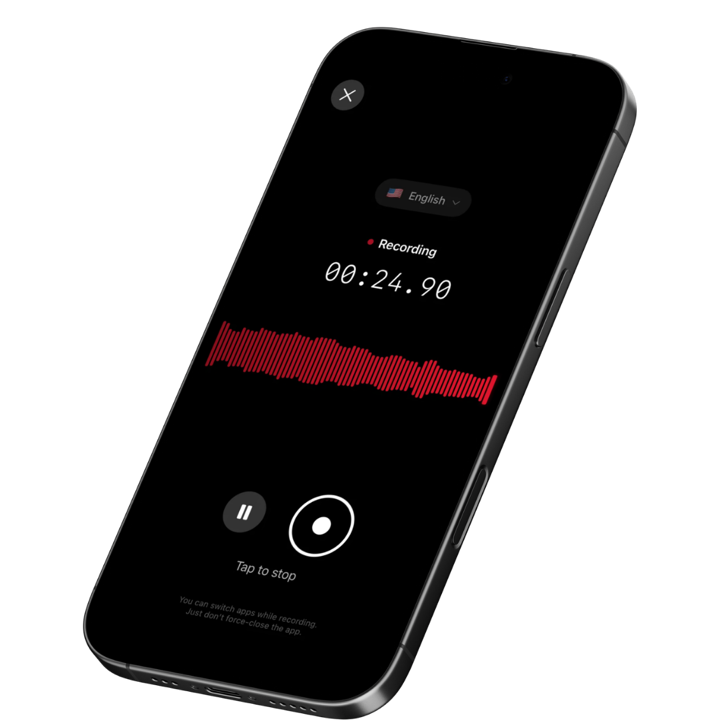
Some of what your team knows starts out as something said out loud, in a meeting, a lecture, or a quick conversation, and then it has to travel to someone who was not there. Speakwise is an iPhone app that records in-person conversations, meetings, lectures and interviews with one tap, and turns them into a transcript and an AI summary with action items.
Instead of writing up notes from memory later, or waiting for someone to circle back with what was decided, you get a transcript and summary of the recording. You can share it by link, export it as a PDF, or sync it to Notion, so the person who needs the answer does not have to wait for you to remember it or repeat it out loud. Speakwise works offline, covers 100+ languages, and users report saving about 73% of their post-meeting follow-up time (Speakwise user surveys).
Try Speakwise free for 7 days ($0.00). After that, it starts at $69.99 per year, which is about $5.83 a month, billed yearly. Prices shown are for the US and can differ by country.Download Speakwise from the App Store and turn today's conversation into a transcript and summary the next person can actually use.
Try Speakwise free for 7 days
Available on the App Store | iOS Optimized

🎯 4.9★ App Store Rating | 📱 Built for iOS
