Lecture Recording Statistics 2027: How Students Use Them
TL;DR
Lecture recording statistics show most students use recordings to study. A 2018 Australian study found that about 75% of students used their lecture recordings (Chapin, AJET 2018). Speakwise turns a recorded lecture into a study summary with exam points, free to try for 7 days.
Used by recruiters, executives, consultants, and more.
Lecture Recording Statistics 2027: How Students Use Them
Lecture recording statistics show how far recording has come, from one professor with a tape machine to lecture halls wired to save every class automatically the moment a professor starts talking. The real questions are how students actually use what gets recorded, who benefits most, and what happens to attendance and grades once recordings exist. This post gathers 15 sourced statistics that answer those questions.
Key Lecture Recording Statistics (2027)
- Lecture recording is common on campus: 75.3% of students in a 2018 Australian study accessed their recorded lectures (Chapin, AJET 2018).
- Exam prep was the most common main reason to use recordings: 30.8% of users said so, just ahead of the 25.0% who had missed the lecture (Chapin, AJET 2018).
- A UK study found 75% of students used their lecture recordings, but only 10% opened every single one (Leadbeater et al., 2013, cited in Chapin, AJET 2018).
- Attendance can fall once recordings arrive: a study comparing 161 students before and 160 after lecture capture found attendance dropped, and lower attendance went with lower grades (Edwards and Clinton, 2019).
- Grades do not always suffer: one small study found no significant difference in self-reported final grades between heavy and light users of recordings (Chapin, AJET 2018).
- 84% of more than 2,835 students across 11 institutions in the US and Australia said lecture capture helped them understand course material better than a lecture alone, in a 2012 survey reported by Echo360 (Echo360).
- 85% of US students said video technology enhances their learning, in Panopto's own 2024 survey of students at over 1,500 colleges (Panopto).
1. 75.3% of students accessed their recorded lectures
75.3% of students accessed their recorded lectures during one semester, according to a 2018 study of 71 psychology students at an Australian university. The researcher, Laurie Chapin, called this a majority, but far from universal. About a quarter of students, 24%, never opened a single recording.
The study used Echo360, which Chapin calls the most common lecture-recording technology at Australian universities. Students could stream or download each class, pause it, and skip straight to a slide they needed.
This figure is close to what a UK study found in 2013, which also put recording use at about 75%. Not every country matches that rate: a Canadian study that logged every enrolled student, instead of relying on volunteers, found only 36% used their recordings (see statistic 6).
Source: Chapin: Australian university students' access to web-based lecture recordings (AJET, 2018)
2. Students who use recordings open about 70% of them
Students who used their lecture recordings did not just open one and stop. On average, they said they opened 69.8% of the recordings available to them during the semester, the same Australian study found. That counts recordings a student opened, not how many minutes they watched inside each one.
Some students went further. Among everyone surveyed, 22.1% said they opened every recorded lecture in the course. At the same time, 24% of students never opened a recording at all.
The researcher called this a wide spread rather than one typical pattern. Some students barely touch recordings, some open a handful of key lectures, and others open every recording in the course. For many students, recordings replace none of the course. For others, they cover most of it.
Source: Chapin: Australian university students' access to web-based lecture recordings (AJET, 2018)
3. 30.8% use recordings to study for exams, 25.0% because they missed class
When asked why they used lecture recordings, 30.8% of the students who used them said their main reason was to study for exams, the most common answer in the 2018 Australian survey, though the gap between reasons was not statistically significant. The next most common reason, picked by 25.0% of students, was simple: they had missed attending the lecture in person.
Other reasons followed close behind. 17.3% said they used a recording because they did not understand part of the live lecture, and 15.4% said they generally could not attend lectures due to work or other commitments.
These answers match how most people imagine recordings get used. Exam review and making up a missed class are the two biggest reasons. Clarifying a confusing moment comes in third. For most students, a recording is a backup and a revision tool, not the main way they first meet new material.
Source: Chapin: Australian university students' access to web-based lecture recordings (AJET, 2018)
4. A UK study found 75% used recordings, but just 10% opened every one
A 2013 study of university students in the United Kingdom, led by researcher Leadbeater, found that 75% of students used their lecture recordings at some point, almost matching the Australian figure above. Chapin's 2018 Australian review reports this UK finding alongside her own results. The study tracked a cohort using Echo360, the same software used in the Australian study.
Within that 75%, use was often light. 52% of the students who opened a recording only did so for one or two lectures all semester, usually to check a few difficult slides. Just 10% opened every recorded lecture.
On average, each lecture was downloaded by about 50% of the student cohort. Together, these numbers show that most UK students dipped into recordings for specific help, rather than rewatching entire lectures or entire courses.
5. Attendance and attitudes differed sharply between a Dutch nursing course and six technical university courses
At Fontys University of Applied Sciences in the Netherlands, 44.7% of the 46 students who answered said they attended every lecture in person, compared with 29.3% of 103 students at Eindhoven University of Technology (TU/e), a 2012 study by researcher Gorissen and colleagues found, reported in Chapin's 2018 review.
Student attitudes also differed sharply by campus. At Fontys, 90.3% of students rated the recordings as somewhat or very effective for succeeding in the course. At TU/e, only 66.5% said the same.
The two campuses used the same recording system, but the courses were not alike. The Fontys group was one first-year nursing course. The TU/e group was six courses in subjects like engineering, architecture and math, mostly with second and third-year students. The researchers said the gap could come from the year level, gender, the course content or the department, and that more research is needed. Rolling out lecture recording is not a single decision with one guaranteed outcome.
6. Weekly use was 8% of all students in Canada and 75% of recording users in Qatar
A 2015 survey of an introductory accounting course in Qatar, by researcher Aldamen and colleagues, asked the 80 students who said they used the lecture recordings. 75% of them said they watched a lecture's recording during the same week it was taught, a figure Chapin's 2018 review counts as weekly use. A separate 2014 Canadian study found a very different pattern: only 36% of all enrolled students accessed their recordings at all, and just 8% did so weekly.
The Canadian study, led by researcher Brooks and colleagues and also reported in Chapin's review, measured access differently. It logged every enrolled student automatically, with no need to opt in, and counted anyone who opened a recording for at least 5 minutes in the whole semester as a user, a bar Chapin calls very generous.
The two studies measured different groups in different ways, so 8% and 75% are not a direct comparison. Still, course design, local habits around attending class, and how a school promotes its recordings likely all shape how much students use recordings.
7. A 2023 UK study found attendance held steady for most, but a third skipped more class
A 2023 survey of 694 biology students at the University of Liverpool in the UK, about 53% of the class, found that lecture capture did not change self-reported lecture attendance for most students. Still, 32% of students said the recordings did affect how often they went to class, and about one in three students said they ended up skipping more lectures because the recording was there as a backup.
This more recent, larger study lands between the two extremes found elsewhere in this post. It does not show the sharp attendance drop that a 2019 UK study found below, but it does not report zero effect either. For most students, having a recording changed nothing about their habits. For a meaningful minority, around a third, it became a reason to skip class more often.
The researchers also found that many students spent so much time rewatching recordings and writing out word-for-word notes that it cut into time for other independent study, and they called for more support so recordings do not quietly replace the habits that help students do well.
Source: Voelkel et al.: Lecture capture affects student learning behaviour (FEBS Open Bio, 2023)
8. 68% of students, but only 3.2% of staff, said they could learn just as well from recordings as from class
A 2010 paper reporting surveys done from 2006 to 2008 across four Australian universities, led by researcher Gosper and colleagues and reported in Chapin's 2018 review, found a sharp gap between students and teaching staff. Among the students who used recordings, 68% agreed they could learn just as well from a lecture recording as from attending in person. Among the staff surveyed separately, only 3.2% agreed with that statement.
The gap was smaller on a related question. 49% of staff said recordings made learning easier in a moderate or significant way, compared with 79.9% of the students who used them.
That gap between staff and student views helps explain why lecture-recording policy is still debated at many schools. Students often see recordings as a clear win. Many staff remain unconvinced that a recording teaches as well as they do in the room, and some worry recordings discourage students from showing up to class.
9. 94.9% of students in an early Singapore study called recordings useful
At Nanyang Technological University in Singapore, 94.9% of 1,140 students who used video-recorded lectures agreed the technology was useful for their studies, a 2006 survey found. Chapin's 2018 Australian review rounds this up to 95% when reporting the study, led by researcher Soong and colleagues. That is higher than every other approval figure in this post.
The study came early in the spread of lecture capture, years before Echo360 and similar systems became standard equipment in lecture halls. Even at that early stage, student reaction was strongly positive: 95.8% of students also said the university should keep recording lectures in future semesters.
The consistency across decades stands out. From 94.9% of students calling recordings useful in Singapore in 2006 to large majorities in the Australian and Dutch studies above, students in different countries have mostly rated recorded lectures as helpful for their learning.
Source: Soong, Chan, Cheers and Hu: Impact of video recorded lectures among students (ASCILITE, 2006)
10. Students in the survey said they attended a mean of 62.1% of lectures in person
Even with recordings available, the 71 students in the 2018 Australian study said they still showed up to class. Participants reported attending a mean of 62.1% of their lectures in person over the semester. This number is self-reported, and Chapin notes that, going by the lecturers teaching these classes, a typical lecture had closer to 25% attendance, much lower than what students recalled.
The spread was wide. 18.2% of students said they attended every single lecture, while 5.2% said they did not attend any lecture in person at all.
This data came from a course where every lecture was recorded and easy to access at any time, which makes the result more notable. The researcher found that attendance and recording use were not simply opposites. About half of the students who attended regularly also used recordings a lot, some to review material they had already seen in person. Students with low attendance leaned more on recordings: 15 of the 20 students who attended less than half their lectures were heavy users of recordings.
Source: Chapin: Australian university students' access to web-based lecture recordings (AJET, 2018)
11. One study found no grade difference between heavy and light users
When researchers compared final grades across different patterns of attendance and recording use, they found no statistically significant difference, F(2, 56) = 0.23, p = .794, in the 2018 Australian study. The grades were self-reported by students who had all passed the course.
Average self-reported final grades were close across every group: 75.5 out of 100 for high-attendance, low-recording-use students, 74.1 for low-attendance, high-recording-use students, and 73.5 for students high on both measures.
In plain terms, how a student mixed attending class with watching recordings did not predict their final mark in this course. Students who leaned heavily on recordings did about as well as students who leaned on attendance instead. The researcher concluded that the flexibility of lecture recording let different students reach similar results through different routes, rather than forcing everyone toward one correct way to use their time.
Source: Chapin: Australian university students' access to web-based lecture recordings (AJET, 2018)
12. A study of 161 and 160 students found attendance dropped once capture arrived
A study published in Higher Education in 2019 compared 161 students before their university introduced lecture capture with 160 students in the same course after recordings became available. The researchers, Edwards and Clinton, found that attendance dropped substantially in matched lectures once recordings were an option.
Unlike the Australian studies above, this study found the drop in attendance mattered. Lower attendance predicted lower final grades, and watching the recordings instead did not make up the difference. The researchers described the overall effect on the group's grades as generally negative.
This finding is more negative than the Australian studies above, which found no significant difference in grades. The honest summary is that the studies disagree, and the results seem to depend on the course and the students, not only on the technology.
13. A survey of 660 students found recordings support students juggling life and class
A 2021 survey of 660 university students in New Zealand, across 132 courses that offered recorded lectures, found that most students saw recordings as a supplement, not a substitute for class. The researchers, Larian Nkomo and Ben Kei Daniel, reported that the availability of recordings did not change most students' decision to attend lectures.
Students who did use the recordings gave familiar reasons: preparing for exams, revising course material, and comparing the recording against the notes they had taken by hand in class.
The study also found that recordings gave extra support to students juggling jobs, family duties, or a medical condition or learning disability alongside their studies. For these students, a recording is not a shortcut around class. It is a way to keep up when life gets in the way of being in the room.
14. 84% of students in a survey reported by Echo360 said lecture capture helped them understand courses better
In a 2012 survey of more than 2,835 students across 11 institutions in the United States and Australia, 84% agreed that blended learning with lecture capture was more effective for understanding course material than a traditional lecture alone. Echo360, a lecture-recording company, reports this survey on its own site and does not say who ran it, so treat the figure as the company's own claim rather than independent research.
Even with that caveat, the sample size is large and spans two countries. A positive response from 84% of several thousand students is hard to dismiss entirely, even from a company with a product to sell.
The finding fits the pattern seen in the independent, peer-reviewed studies above: large majorities of students who try lecture recordings describe them in positive terms, whether the study was run by a university researcher or by the company that built the recording software.
Source: Echo360: Lecture Capture Gets Students' Votes
15. 85% of US students in Panopto's own 2024 survey said video helps them learn
In a 2024 survey of US students at more than 1,500 colleges and universities, 85% said video technology enhances their learning experience, and 68% said they prefer enrolling in courses that offer video content. Panopto, another lecture-capture company, ran the survey with College Pulse and published the results itself, so weigh the numbers as the vendor's own research.
The same survey found 83% of students value the flexibility of on-demand video learning, and 96% said having a searchable portal for all of their class videos is important to them.
Those last two numbers point past simple recording and toward organization. Students do not just want a recording to exist. They want to find the exact moment they need, in a lecture they sat through weeks earlier, without replaying the whole thing from the start.
Source: Panopto: New Research Finds 85% of Students Say Video Technology Enhances the Learning Experience
What These Lecture Recording Numbers Reveal
Across these studies, one pattern repeats. Most students treat recordings as a backup, not a replacement for class. They use recordings to study for exams, to replay a confusing part, or to catch up after they missed a lecture. Few students open every single recording.
The research on attendance and grades is genuinely mixed. Edwards and Clinton found attendance fell once lecture capture arrived, and that lower attendance went with lower grades. A newer 2023 UK study found the opposite for most students: attendance held steady, though about a third of students did skip more class once recordings existed. Chapin's small study found no significant difference in self-reported grades between students who used recordings a lot and those who used them less. Weekly use was 8% of all enrolled students in a Canadian study and 75% of recording users in a Qatar survey, so those two numbers are not a direct comparison. Schools should not assume recordings always help, or always hurt attendance; the course, the students and the subject likely all shape the outcome. For more on how note-taking itself affects memory and grades, see our note-taking productivity statistics.
Recordings also open lectures up to students who need them most. Researchers found that students who are dyslexic or who come from a non-English speaking background are more likely to be heavy users of lecture recordings (Leadbeater et al., 2013, cited in Chapin, AJET 2018), and Nkomo and Daniel found recordings support students juggling a medical condition or a learning disability. As lecture capture becomes close to universal, the real work shifts from whether to record a class to how students use what gets recorded, and what support, like a clear transcript and a short set of study notes, turns a recording into something a student actually studies from.
Students use lecture recordings to study and to catch up on missed classes, but in one UK study about a third also skipped more class once recordings existed, so the bigger question now is support and policy, not whether to hit record.
Turn Your Recorded Lecture Into Study Notes With Speakwise
Once a lecture is recorded, the work is not done. A two-hour recording is not something most students will rewatch end to end, and one UK study in this post found that most students who used recordings only looked at a few difficult slides. If you are choosing a way to record your own lectures, see our breakdown of the best app for recording lectures.
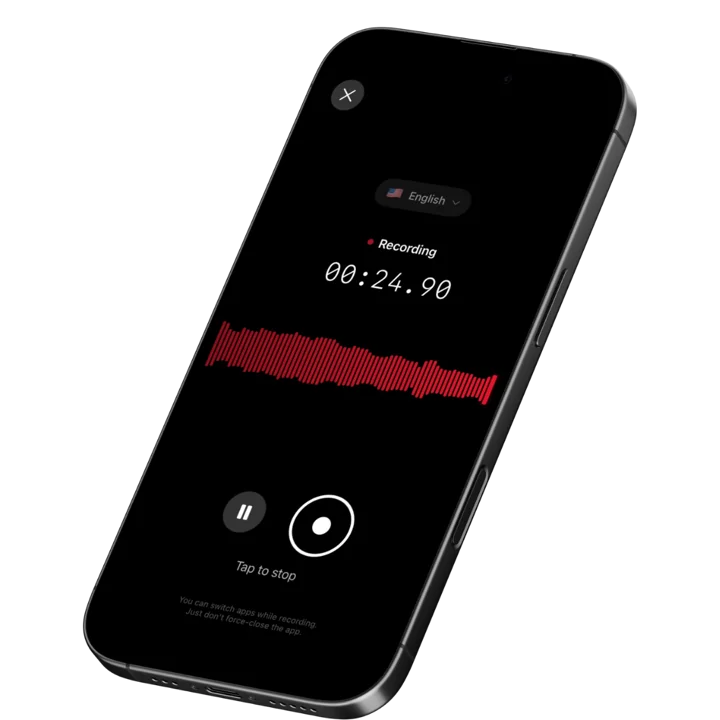
Speakwise is an iPhone app that records a lecture with one tap and turns it into a transcript and an AI summary with key points. The Lecture & study notes template turns a recording into concepts, key facts, examples and exam points. It works offline, so a recording keeps going even with no signal in a basement lecture hall, records up to 5 hours in one sitting, and reaches 95%+ accuracy in optimal audio conditions and 92%+ in noisy rooms with several speakers. Speakwise also writes transcripts in 100+ languages with automatic language detection. See our full breakdown of the best transcription app for students for more on choosing a tool. Recording a lecture is a privilege, not a right: always follow your school's and professor's rules on recording, and never record a class without permission.
Start with a 7-day free trial ($0.00). After that, Speakwise costs from $69.99 per year, which is about $5.83 a month, billed yearly. Prices shown are for the US and can differ by country.Download Speakwise from the App Store and turn your next lecture into a transcript, an AI summary and study notes.
Try Speakwise free for 7 days
Available on the App Store | iOS Optimized

🎯 4.9★ App Store Rating | 📱 Built for iOS
