Productive Hours Statistics 2026: Time Tracked as Productive
TL;DR
Productive hours statistics show that ActivTrak's software counts 6 hours and 36 minutes of a typical workday as productive time. Full-time employees worked 8.1 hours on the days they worked in 2025, government data shows. This post has 15 statistics on productive time and long hours. Speakwise records your meeting and writes the transcript, summary and action items for you.


Used by recruiters, executives, consultants, and more.
Productive Hours Statistics 2026: Time Tracked as Productive
Productive hours statistics show that employees spend about 6 hours and 36 minutes of an 8-hour, 44-minute workday in apps and sites that ActivTrak's own tracking software counts as productive, according to its 2026 State of the Workplace report. A narrower measure tells a harsher story: a 2019 RescueTime report on 2018 data from 185 million tracked hours found that knowledge workers averaged just 2 hours and 48 minutes a day of productive device time. Full-time US employees worked an average of 8.1 hours on days they worked in 2025, government time-use data shows, so paid time and productive time are not the same thing. A 2014 Stanford analysis of British munitions factory records from World War I found that weekly output peaked at about 63 hours and barely differed between 56 and 70 hours, so for those workers longer weeks stopped paying off. The famous claim that workers are productive for only 2 hours and 53 minutes a day traces to a company survey, not a time-tracking study.
Nobody has unlimited focus in a day. Every hour spent on email, chat, meetings and switching between apps is an hour that cannot go toward writing a report, closing a deal or solving a hard problem. Some people also do work in the evening, and Microsoft researchers say they do not yet know why. The real question is not how many hours someone is logged in, but how many of those hours produce anything. Self-reported surveys, device-tracked software and century-old labor studies all point to the same pattern from different angles.
This post is for anyone who wants an honest answer to how many hours of a workday are actually productive, not just paid. It separates measured data from famous marketing surveys, looks at what happens to output once hours stretch past a point, and shows when in the day people tend to do their best work. It covers 15 sourced statistics in total.
Key Productive Hours Statistics (2026)
- Productive hours statistics show that employees spend about 6 hours and 36 minutes of an 8-hour, 44-minute workday in apps and sites that ActivTrak's own software counts as productive, per its 2026 State of the Workplace report (ActivTrak).
- A 2014 Stanford analysis of British munitions workers in World War I found that weekly output peaked at about 63 hours, and output at 70 hours barely differed from output at 56 hours (Pencavel, 2014).
- On days they worked, full-time US employees worked an average of 8.1 hours in 2025 (BLS American Time Use Survey).
- In a 2021 Microsoft study of some of its own employees, about 30% had a third, evening peak of work activity on top of the usual two midday peaks (Microsoft WorkLab).
- The famous claim that workers are productive for only 2 hours and 53 minutes a day traces to a self-reported survey of 1,989 UK office workers, not a time-tracking study (Vouchercloud).
- In 2021, DeskTime's most productive users worked in 112-minute stretches followed by a 26-minute break, up from the 52-17 pattern the company first found in 2014 (DeskTime).
- Average annual working hours in Germany fell from more than 3,000 in the late 1800s to under 1,500 in the 2010s, a decline of nearly 60% (Our World in Data).
1. ActivTrak counts 6 hours and 36 minutes of an 8-hour, 44-minute workday as productive
6 hours and 36 minutes is how much time employees spent per day in 2025 inside apps and sites that ActivTrak's own software counts as productive. That is the company's own classification of work activity, not an independent measure of real output. The same company data put the average workday at 8 hours and 44 minutes of screen time. ActivTrak says this includes busywork and multitasking as well as productive time. Both figures come from ActivTrak's 2026 State of the Workplace report, which tracked more than 440 million hours of work activity across 1,100+ companies.
The trend is moving in a good direction, by ActivTrak's own measure. The company found the average workday had shrunk by 2% since 2023, when it ran 8 hours and 53 minutes, while time counted as productive rose 5% over the same period. People are spending less time logged in, and more of that smaller window falls into ActivTrak's productive category.
Even so, 6 hours 36 minutes counted as productive inside an 8-hour, 44-minute day still leaves roughly 2 hours of screen time that ActivTrak does not count as productive, such as busywork.
Source: ActivTrak: State of the Workplace, Workday Patterns
2. Full-time employees worked an average of 8.1 hours on the days they worked in 2025
8.1 hours is the average full-time employees worked on days they actually worked, according to the Bureau of Labor Statistics' 2025 American Time Use Survey. That splits into 8.5 hours on a typical weekday and 5.5 hours on a typical weekend day, when fewer full-time employees work at all.
This is a measure of hours worked, not hours productive. The government counts someone as working for the whole time they are at their job or doing job tasks at home, whether or not every minute produces something. That is why it should not be confused with device-tracked productive-time numbers like the one above.
The gap is large. ActivTrak's device-tracked data above puts productive time at 6 hours 36 minutes a day, and RescueTime's narrower measure, from its 2018 data and covered in our focus time statistics roundup, puts it at just 2 hours 48 minutes. Three credible sources, three very different answers, all depending on what counts as work.
Source: Bureau of Labor Statistics: American Time Use Survey News Release
3. Healthcare workers get the most daily focus time, 4 hours 47 minutes. Financial services workers get 4 hours 1 minute
4 hours and 1 minute is the average daily focus time ActivTrak measured for financial services employees, which ActivTrak says is below the overall average. Focus time means the total time in a day that an employee works on one task with no interruptions, no switching and no teamwork, not just any productive activity. Healthcare employees had the most focus time, at 4 hours and 47 minutes a day.
The gap matters because focus time is where deep, difficult work gets done. Financial services workers still had strong overall productive time, 6 hours and 32 minutes, so a shorter focus window does not always mean less total output. It can mean the same work gets split into more, shorter sessions.
ActivTrak's data covers 774 companies and 218,900 employees, tracked from January 2022 to December 2024.
Source: ActivTrak: Productivity Benchmarks Report 2025
4. In ActivTrak's 2022 to 2024 data, remote workers got 6 hours 47 minutes of productive time, more than hybrid workers
From 2022 to 2024, ActivTrak measured an average of 6 hours and 47 minutes of productive time a day for fully remote employees, the highest of any work arrangement it tracked (147 companies, 41,924 employees). Hybrid employees, who split time between home and an office, showed lower productive time, down by 8 minutes or more compared with remote work.
The finding runs against a common worry that remote work invites slacking off. Instead, the data points the other way: remote employees logged more measured productive activity in a day. ActivTrak's benchmark report does not say why. Its 2026 guide says remote work often removes common workplace interruptions, but neither report tests the reason.
This does not settle whether remote work is better for every job. Some roles need in-person coordination that activity-tracking software cannot capture. But for the hours it can measure, working from home came out ahead.
Source: ActivTrak: Productivity Benchmarks Report 2025
5. High school graduates with no college worked more hours on an average weekend than those with a bachelor's degree
On an average weekend day in 2025, employed people who finished high school but did not go to college worked 6.4 hours, compared with just 4.0 hours for employees with a bachelor's degree or higher. That comes from the Bureau of Labor Statistics' American Time Use Survey, which counts only the hours people worked on days they worked at all.
The gap shows that how many hours people really work depends on who you ask, not just which day of the week it is. The BLS release does not say why. It only reports the gap in hours.
This matters for any claim about a typical workday. The 8.1 hour average reported earlier in this post blends very different realities together, and education level is one of the clearest lines that splits those realities apart.
Source: Bureau of Labor Statistics: American Time Use Survey News Release
6. 35% of employed people did some or all of their work at home on days they worked in 2025
35% of employed people did some or all of their work at home on days they worked in 2025, the Bureau of Labor Statistics found. Women were more likely to do so than men: 38% compared with 31%.
Where work happens changes how productive hours get used. A commute that disappears can become extra focus time, extra sleep, or extra time on a side task, depending on the person. ActivTrak's separate finding that remote employees log more productive time than hybrid employees, covered above, points in the same direction: location is not neutral.
This does not mean office work is less productive. It means about a third of employed people did some of their work at home on the days they worked in 2025, somewhere an employer cannot see it directly.
Source: Bureau of Labor Statistics: American Time Use Survey News Release
7. Employed adults with a child under 6 get over an hour less leisure time a day
4.5 hours is the average time employed adults with no children under 18 spent on leisure and sports activities per day in 2025. Employed adults with a child under age 6 averaged just 3.2 hours, over an hour less, according to the Bureau of Labor Statistics.
Leisure time connects to productive hours because rest is part of how people sustain focus day after day. A shorter recovery window for parents of young children does not show up in a workday-length number, but it can still affect how much energy is left for demanding work.
This is also a reminder that a workday is only part of a person's 24 hours. Two employees can work the identical 8 hours and still arrive the next morning with very different amounts of real rest behind them, which shapes how productive that next day can be.
Source: Bureau of Labor Statistics: American Time Use Survey News Release
8. The famous 2 hours 53 minutes claim comes from a marketing survey, not a time-tracking study
2 hours and 53 minutes is the number behind one of the most repeated productivity claims online: that the average office worker is only productive for that long out of a full workday. It comes from Vouchercloud, a UK discount-code website, which polled 1,989 UK office workers and asked them to estimate their own productive time.
That is the problem. The number is a self-reported guess, not a measurement from time-tracking software. The same survey found that 79% of respondents did not think they were productive the entire day, and the top named distractions were checking social media and reading news websites.
The survey's exact date is unclear. Vouchercloud's own page carries a 2018 publish timestamp, and other sites have been recirculating the same claim since at least 2017 without naming an original survey year. Either way, an old, self-reported, company-run survey is a weak basis for a number still repeated as current fact. See our time management statistics for more on how workers spend the day.
Source: Vouchercloud: Office Worker Productivity
9. DeskTime's famous 52-17 pattern became 112-26 by 2021: the work stretch more than doubled
52 minutes of work followed by a 17-minute break was the pattern DeskTime found in 2014 when it studied the most productive 10% of users of its time-tracking software. The finding spread widely as a kind of ideal work rhythm.
It has not held up as a fixed rule. DeskTime also looked at its data from February 2020, just before the pandemic, and found an 80-17 pattern, 80 minutes of work to a 17-minute break. By 2021, the company's most productive users averaged 112 minutes of work followed by a 26-minute break, more than double the original 52 minutes.
DeskTime's own data shows the "right" work-to-break ratio has changed every time the company has measured it. That is useful information on its own: there is no single magic number for a focused work session, only a rough pattern of working in bursts and then stepping away.
Source: DeskTime: Does the 52-17 Rule Really Hold Up?
10. A Stanford analysis found output stops rising after about 63 hours a week
63 hours a week is roughly where output stopped rising in a landmark study of British munitions workers during World War I, reanalyzed by Stanford economist John Pencavel in 2014. At the time, working 70 to 90 hours a week was common for men, and some worked more than 100. A survey the paper cites as background found that a majority of 1,326 women in munitions factories worked more than 60 hours a week.
Pencavel found that output rose in step with hours only up to about 49 hours a week. Beyond that point, output kept growing, but more slowly, until it peaked at around 63 hours. Past that, adding more hours added nothing: output at 70 hours a week was barely different from output at 56 hours.
The lesson is not that everyone should aim for a 49 or 63-hour week. It is that beyond a certain point, measured here with real factory output rather than a survey, longer hours stop buying more work and start buying only fatigue.
Source: Pencavel: The Productivity of Working Hours (IZA Discussion Paper 8129)
11. Weeks without a rest day had about 10% lower output, even at the same total hours
10% is about how much lower weekly output was in weeks without a day of rest, compared with weeks at the same total hours that included one, according to Pencavel's reanalysis of the WWI-era munitions data.
This finding separates two things people often mix up: total hours worked, and how those hours are spread across the week. Two workers can log the identical number of hours in a week and still produce different amounts, depending on whether one of them had a full day off.
It lines up with the modern idea of protecting a small number of genuinely productive hours rather than just adding more of them. A rest day is not time taken away from output. In this data, it was part of what made the rest of the week's hours count.
Source: Pencavel: The Productivity of Working Hours (IZA Discussion Paper 8129)
12. Classic research found no benefit from more than 4 hours of focused practice a day
Around 4 hours a day is how much deliberate practice the top violinists and expert pianists did in a 1993 study by Anders Ericsson, Ralf Krampe and Clemens Tesch-Romer. Deliberate practice is the effortful, focused work needed to build real skill. The study's authors say the finding raises the possibility of a general daily limit on it.
The paper also reviewed other real-world training studies and found something sharper: practice beyond 4 hours a day showed essentially no added benefit, and the benefit was already shrinking past 2 hours. Chess masters, long-distance runners and even productive novelists showed similar daily limits in the studies it cites.
This is not a rule every job follows. But it is strong, long-standing evidence that highly demanding, focused mental work has a real daily ceiling, one that shows up again and again across very different fields.
13. In Germany, average working hours have fallen by nearly 60% since the late 1800s
Nearly 60% is how much average annual working hours have fallen in Germany since the late 1800s, according to Our World in Data's analysis of historical labor records. Hours fell from more than 3,000 a year to under 1,500, as the workweek shortened and paid vacation time spread.
The data, compiled by economic historians Michael Huberman and Chris Minns and extended with modern Penn World Table figures, covers early-industrialized economies broadly, not just Germany. Most of them show the same long decline, driven by shorter workdays, fewer work days per year, or both.
This long view matters for any claim about the number of productive hours in a day. Yearly working hours in early-industrialized countries have been roughly cut in half since 1870, yet the productive share of a workday, by the device-tracked numbers above, still lands under 8 hours.
Source: Our World in Data: Working More Than Ever
14. About 30% of the Microsoft employees studied in 2021 had a third work peak in the evening
30% is roughly the share of the Microsoft employees studied in summer 2021 who had a third peak of work activity in the evening, a pattern researchers call the triple peak day. Knowledge workers have long shown two peaks, one before lunch and one after. The third, smaller peak shows up in the hours before bedtime.
Microsoft's researchers measured this through keyboard usage, which showed an evening spike in work for roughly 3 in 10 of the employees studied. The same 2021 article cites separate Microsoft Work Trend Index data: the average Teams user sent 42% more chats per person after hours. Early in the pandemic, the biggest rise in after-hours chats came between 6 p.m. and 8 p.m.
Whether that evening peak is genuinely productive or just work spilling into personal time is still an open question. Either way, when people work no longer fits neatly into one block for a meaningful share of the workforce.
Source: Microsoft WorkLab: Triple Peak Day
15. World War I munitions workers who alternated day and night weeks were not less productive at night
No significant difference is what a British study of munitions workers during World War I found when it compared the output of night shift and day shift workers on an alternating weekly schedule, reanalyzed by Stanford economist John Pencavel in 2014. If anything, output was slightly higher on the night shift for some kinds of work.
That finding applied to a "discontinuous" schedule, where a group of workers alternated one week of day work with one week of night work, always with a day of rest built in. A different, continuous schedule, where some women worked nights for long stretches without switching back, produced clearly worse output. The investigators concluded that constant night work, without a break from it, denied workers the sleep and rest they needed.
The lesson is not that night work is automatically fine. It is that the schedule's structure mattered more than the clock time, which is a useful challenge to the assumption that a fixed daytime block is the only arrangement that can be productive.
Source: Pencavel: The Productivity of Working Hours (IZA Discussion Paper 8129)
What the Productive Hours Numbers Really Show
Put the measured numbers side by side and a clear picture forms. Device-tracked data puts real productive time at 2 hours 48 minutes a day in RescueTime's 2018 numbers and 6 hours 36 minutes a day in ActivTrak's 2025 numbers, government data puts hours worked at 8.1 hours, and the famous 2 hours 53 minutes figure turns out to be a self-reported guess from a marketing survey, not a measurement. None of these numbers agree on an exact figure, but all of them agree on the direction: a full workday and a productive workday are not the same thing.
The hours-and-output research adds a second layer. Pencavel's century-old data shows that output does not keep climbing with longer hours. It peaks around 63 hours a week and then flattens, while weeks without a rest day had about 10% lower output at the same total hours. Ericsson's research on deliberate practice points to a different kind of limit from a different field: about 4 hours a day of very demanding, focused practice looks like a realistic limit, not a lack of discipline.
Timing adds a third layer. In 2021, Microsoft found that about 30% of the employees it studied had a third work peak in the evening, and Teams users sent more chats after hours. None of this means people should work longer. It means a workday is better measured in a small number of genuinely productive hours than in a large number of hours spent logged in.
Where tools measure productive time directly, it comes out under a full workday: about 2 hours 48 minutes in RescueTime's 2018 data and 6 hours 36 minutes in ActivTrak's 2025 data.
Get Your Meeting Notes Done With Speakwise
If real productive time is only a few hours a day, writing down what was said, chasing action items and typing up a summary afterward all use some of it. None of that needs to eat into the narrow window where real work gets done.
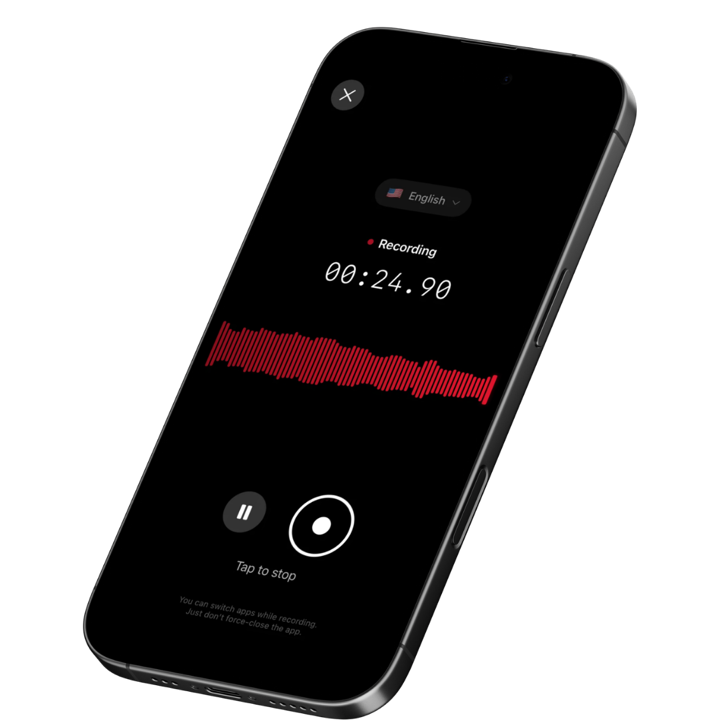
Speakwise is an iPhone app that records in-person conversations, meetings, lectures and interviews with one tap. It turns the recording into a transcript with speaker identification, then writes an AI summary with key points and action items. Users report saving about 73% of their post-meeting follow-up time (Speakwise user surveys). Speaker identification is not included in every plan. When you start your free trial, pick the plan that includes it.
It works in 100+ languages, records up to 5 hours in one recording, and works offline: it records with no internet and transcribes when you are back online. Start recording hands-free from the iPhone Action Button or Control Center. For more on when people do their best work, see our morning productivity statistics.
Try Speakwise free for 7 days ($0.00). After that, it starts at $69.99 per year, which is about $5.83 a month, billed yearly. Prices shown are for the US and can differ by country.Download Speakwise from the App Store and turn your next meeting into a transcript, summary and action items.
Try Speakwise free for 7 days
Available on the App Store | iOS Optimized

🎯 4.9★ App Store Rating | 📱 Built for iOS
