Average Reading Speed Statistics 2026: WPM by Age
TL;DR
Average reading speed statistics for 2026 show adults read English nonfiction silently at about 238 words a minute, in a 2019 review. Reading aloud is slower, at about 183 words a minute. This post covers 17 statistics on reading speed by age, grade, and language. Speakwise turns a recording into a transcript and summary to read instead of replaying it.
Used by recruiters, executives, consultants, and more.
Average Reading Speed Statistics 2026: WPM by Age
Average reading speed statistics show that adults read nonfiction silently at about 238 words a minute, based on a 2019 meta-analysis of 190 studies and 18,573 people. Reading aloud is slower, at about 183 words a minute, while fiction may read a bit faster, at about 260 words a minute. Reading speed changes with age and schooling: a median first grader reads aloud 60 words a minute in spring, rising to 146 by sixth grade, and speed later declines after about age 50. This post covers 17 reading speed statistics by age, school grade, language, and screen versus paper.
Most people have never timed their own reading and have no number to compare it with. A typing test or a speaking rate is easy to picture, but reading speed usually stays a mystery until a teacher, an eye doctor, or a researcher measures it.
Most numbers below come from peer reviewed studies in psychology, education, and vision science. Two come from other sources: a school reading norms report and an audiobook site's help page. This post covers 17 reading speed statistics: the one number that answers "how fast do people read," how that number changes by age, school grade, and language, what happens to understanding when people try to read faster than normal, and how reading stacks up against listening.
Key Average Reading Speed Statistics (2026)
- Average reading speed for adults is about 238 words a minute when reading nonfiction silently, based on a meta-analysis of 190 studies and 18,573 people (Brysbaert, 2019).
- Reading aloud is slower than silent reading, at about 183 words a minute, nearly a quarter less than 238 (Brysbaert, 2019).
- Fiction may read a bit faster than nonfiction, at about 260 words a minute silently, an estimate from one small study and a word-length calculation (Brysbaert, 2019).
- Reading aloud more than doubles across elementary school, from a spring median of 60 words correct a minute in grade 1 to 146 in grade 6 (Hasbrouck and Tindal, 2017).
- In a 2019 study of 200 adults who read short test sentences aloud from an eye chart, speed was steady until about age 50, then lower in older groups: 236 words a minute at ages 40 to 44 and 189 at ages 70 to 74 (Radner and Benesch, 2019).
- People understand text slightly better on paper than on a screen, a small gap (Hedges' g of -0.21) found in 54 studies with 171,055 readers, most of them in four large studies, and not found for narrative texts (Delgado et al., 2018).
- Speed reading claims do not hold up: skilled readers already read 200 to 400 words a minute, and reading faster trades off against understanding (Rayner et al., Psychological Science in the Public Interest, 2016).
1. Adults read about 238 words a minute silently
238 words a minute is the average silent reading speed for adults reading nonfiction in English. The figure comes from a 2019 meta-analysis that combined 190 studies and 18,573 participants, the first systematic review of reading speed, covering every study the author could find from 1901 to 2019. Older estimates often quoted 250 to 300 words a minute, but those numbers were rarely checked against real data.
This is the best current estimate for a normal adult reading a normal nonfiction text, with no special training. It holds for adults between 18 and 60 years old who do not have a reading disability. At this pace, a 1,000 word article takes a little over four minutes to read. Every other number in this post is worth comparing back to this one baseline.
2. Reading aloud is slower, at about 183 words a minute
183 words a minute is the average rate when adults read a text out loud, according to the same 2019 meta-analysis, this time covering 77 studies and 5,965 participants. That is about 55 words a minute slower than silent reading of nonfiction.
Reading aloud forces a reader to actually produce every word as speech, which takes time that silent reading skips. The researcher who ran the analysis noted that 183 words a minute lines up well with normal speaking rates, since reading aloud is, in effect, a kind of speaking. It also means that listening to someone read a page out loud will always take noticeably longer than reading that same page yourself.
Source: Brysbaert, "How Many Words Do We Read per Minute?" (Journal of Memory and Language, 2019)
3. Fiction may read faster than nonfiction: about 260 words a minute
260 words a minute is the average silent reading speed for fiction, about 22 words a minute faster than nonfiction. The author got this from a small study in which 48 regular readers timed themselves reading a fiction book of their choice (17 of the books were in English), and from a word-length calculation that predicts about 261. His own test could not tell 260 apart from the 238 words a minute nonfiction average.
The gap lines up with a simple explanation: nonfiction tends to use longer words than fiction. Longer words take more time to process, which pulls the nonfiction average down even when the underlying reading skill is the same. So the faster fiction number fits a simple pattern: English fiction uses shorter words (4.2 letters on average, against 4.6 in nonfiction), and shorter words are quicker to read.
Source: Brysbaert, "How Many Words Do We Read per Minute?" (Journal of Memory and Language, 2019)
4. Reading speed ranges from 175 to 300 words a minute for most adults
175 to 300 words a minute is the normal range for adult silent reading of nonfiction, according to the 2019 meta-analysis. For fiction, the normal range runs from 200 to 320 words a minute. Both ranges are wide enough that a "slow" reader and a "fast" reader can differ by well over half.
This matters because a single average hides how much people vary. Someone reading nonfiction at 300 words a minute is not unusually gifted; they are simply at the fast end of a normal range. Someone at 175 is not a weak reader either. Comparing your own pace to a wide, normal range is more useful than comparing it to one average number.
Source: Brysbaert, "How Many Words Do We Read per Minute?" (Journal of Memory and Language, 2019)
5. Reading fluency more than doubles from grade 1 to grade 6
60 words correct per minute is the median spring score for a first grader reading aloud, according to the 2017 update of the Hasbrouck and Tindal oral reading fluency norms, a widely used US benchmark for oral reading fluency. By spring of grade 3, the median rises to 112. By spring of grade 6, it reaches 146, more than double the grade 1 score.
Schools use these norms to spot students who are falling behind their grade level in fluency. The steep early growth also shows why "words per minute" means something very different for a 6 year old than for an adult. Fluency in school years is still being built, not just used.
Source: Hasbrouck and Tindal: Oral Reading Fluency Data 2017 (Read Naturally)
6. In one study, 90 college students averaged 231 words a minute on a standard reading test
231 words a minute is the average silent reading rate that Lewandowski and colleagues measured in 90 college students in a 2003 study using the Nelson-Denny Reading Test, a standardized test used on many US campuses, as reported in Brysbaert's 2019 reading rate meta-analysis. The same students read aloud at 189 words a minute, and their two scores correlated with each other.
This number sits close to the 238 words a minute adult average, but it is not a separate check, because this study is one of the 190 that make up that average. The test's own published norm is a little higher, at 250.
7. Reading speed holds steady until about age 50, then falls
236 words a minute was the average reading speed for adults aged 40 to 44, the fastest age group in a 2019 study of 200 adults with healthy eyes published in the British Journal of Ophthalmology. Older groups read slower, down to 189 words a minute for adults aged 70 to 74. Different people were tested at each age, and they read short test sentences aloud from an eye chart.
The researchers found that reading speed, along with reading vision scores, stayed essentially flat from age 25 to 54. The decline showed up between the 50 to 54 and 55 to 59 age groups, which the study calls the break point. In plain terms, reading speed is not something that quietly fades through adulthood. It holds its ground for decades, then drops.
8. English readers average 236 words a minute, in the upper half of the languages tested
236 words a minute is the average silent reading speed for English in a cross-language comparison inside the 2019 meta-analysis, based on 144 separate studies. Italian readers averaged even more, at 285 words a minute. Arabic readers averaged 181 words a minute, the slowest of the languages with enough data to compare.
How many words a language needs to say the same thing explains part of the gap. Languages where translated texts need more words than English to say the same thing tend to show higher words-per-minute scores, and languages that need fewer words show lower scores. Brysbaert found a moderate link between that number and silent reading speed in words per minute (r = .55 across 12 languages).
Source: Brysbaert, "How Many Words Do We Read per Minute?" (Journal of Memory and Language, 2019)
9. Reading aloud by language ranges from 133 to 191 words a minute
133 words a minute was the slowest average reading-aloud speed among languages checked in the same cross-language comparison, recorded for Korean. Spanish came in fastest among those tested, at 191 words a minute. German averaged 169 words a minute aloud and Chinese 152 (a count estimated from characters), despite very different writing systems.
Just as with silent reading, the gaps mostly track how many words a language needs to carry the same meaning. Brysbaert also found that a language's silent and oral reading speeds tend to move together: languages that read faster silently also tend to read faster aloud, though the link is far from perfect.
Source: Brysbaert, "How Many Words Do We Read per Minute?" (Journal of Memory and Language, 2019)
10. Paper beats screens for reading comprehension
171,055 participants across 54 studies published between 2000 and 2017 were combined in a 2018 meta-analysis comparing reading on paper with reading on screens, though most of those readers, 165,778, came from just four large studies. People understood what they read better on paper than on a screen, a reliable gap researchers size at a Hedges' g of -0.21 (a standard way to measure the size of a difference; the number itself is small, but it held up across dozens of separate studies).
The paper advantage also grew stronger over time: studies from later years in the 2000 to 2017 window showed a bigger gap than earlier ones. The authors found no evidence that growing up with digital devices was closing that gap. If anything, it was moving the other way.
Source: Delgado et al., "Don't Throw Away Your Printed Books" (Educational Research Review, 2018)
11. The screen disadvantage grows under time pressure
A Hedges' g of -0.26 was the size of the paper advantage when readers worked under a time limit, compared with just -0.09 when they could read at their own pace, in the same 2018 meta-analysis. That means the screen penalty was about three times larger when people were rushed.
The authors say their results do not pin down the cause. They point to earlier work suggesting that time pressure pushes people to read in a shallow way, and that this hurts more on screens, where people are used to quick tasks. Under relaxed, self-paced conditions, paper and screens come much closer to even. That detail matters for anyone reading on a screen during a packed workday rather than at leisure.
Source: Delgado et al., "Don't Throw Away Your Printed Books" (Educational Research Review, 2018)
12. The paper advantage disappears for fiction
A Hedges' g of 0.01, statistically no difference at all, was the size of the screen effect when studies used only fiction or other narrative texts, according to the 2018 meta-analysis. For nonfiction texts, and for studies that mixed nonfiction and fiction, paper still won clearly, with Hedges' g values of -0.27 and -0.30.
So the screen penalty is not a blanket rule. It shows up for the kind of dense, informational reading people do for work and school, and it was not found in the 7 comparisons that used only narrative texts. That is a small group, so it does not show that screens are fine for a novel.
Source: Delgado et al., "Don't Throw Away Your Printed Books" (Educational Research Review, 2018)
13. Speed reading claims do not hold up under testing
200 to 400 words a minute is what skilled readers already achieve without any speed reading training, according to a 2016 review in Psychological Science in the Public Interest by Keith Rayner and four co-authors. The review looked at decades of research on speed reading programs and apps that promise to double or triple normal reading speed.
Its conclusion was blunt: there is a real trade-off between speed and accuracy. The research the authors reviewed found that as readers spend less time on a text, they understand it less well, not just as slightly, but as a direct, measurable trade. The way to read faster while still understanding the text is to build reading skill and vocabulary over time, not to adopt a trick.
14. One 1982 study put the speed limit for taking in information near 300 words a minute
300 words a minute is the point where people take in the most information per minute, whether they are listening or reading, according to a 1982 study by the psychologist Carver, as reported in Brysbaert's 2019 reading rate meta-analysis. Carver called it the ideal rate for simple information pickup, for both spoken and written language. Other studies put it lower, at about 275 words a minute or less.
Reading faster than that ceiling does not help a reader absorb more. It uses the same amount of time to take in less, because understanding cannot keep pace with the incoming words. This is the research-backed reason speed reading claims above a few hundred words a minute run into a wall: the bottleneck is comprehension, not eye movement.
15. Healthy young adults can still understand speech sped up to 260 words a minute
260 words a minute is about the limit at which healthy young adults can still understand speech that has been sped up, or compressed, a conclusion Brysbaert draws in his 2019 reading rate meta-analysis from the wider research on compressed speech. Children, older adults, and people listening in a second language lost comprehension before reaching that speed.
That ceiling sits close to the 238 to 260 words a minute range for normal silent reading. The two limits lining up is one reason Brysbaert's review argues that reading and listening share some of the same mental bottleneck, even though reading uses the eyes and listening uses the ears. For anyone who speeds up a recording to save time, 260 words a minute is a speed this research found still understandable for healthy young adults.
Source: Brysbaert, "How Many Words Do We Read per Minute?" (Journal of Memory and Language, 2019)
16. When people know they must answer questions without the text, reading slowed to about 93 words a minute
93 words a minute is how slow silent reading became when readers were told they would have to answer questions afterward without looking back at the text, in a 2001 study by Kemper and Sumner, as reported in Brysbaert's 2019 reading rate meta-analysis. That is less than half the normal 238 words a minute nonfiction average.
The drop held true for both young and older adults in the study. Other studies in the same review found similar slowdowns, at about 104 to 130 words a minute. When people know they cannot look back, they read more slowly, and speed falls by more than half.
17. Audiobooks are narrated at about 140 to 180 words a minute
140 to 180 words a minute is the typical pace for spoken audiobook narration, according to research cited in the 2019 reading rate meta-analysis. ACX, a site where authors and narrators make audiobooks, says most performers narrate about 9,300 words per hour on average, which works out to about 155 words a minute, right in the middle of that range.
That is far slower than silent reading of the same book, which would run at about 260 words a minute for fiction. Listening to an audiobook takes meaningfully longer than reading the same pages yourself. Real conversation runs at about 196 words a minute, so the gap with silent reading is smaller than for an audiobook, but reading is still faster than listening.
Source: Brysbaert, "How Many Words Do We Read per Minute?" (Journal of Memory and Language, 2019) and ACX: Producing and Recording Your Audiobook
What These Reading Speed Numbers Reveal
Three patterns stand out. First, format matters more than people expect: fiction reads faster than nonfiction, reading aloud is slower than reading silently, and screens hurt comprehension for nonfiction but not for fiction. Second, reading speed is not fixed over a lifetime. It builds steeply through school, holds flat through most of adulthood, and only declines after about age 50.
Third, every attempt to push reading speed far past normal runs into the same wall: comprehension. Speed reading programs, rapid word-flashing apps, and sped-up audio all run into the same problem: understanding cannot keep up with new words, at a point the studies above put at a few hundred words a minute. Past that point, more speed just means less understanding, not a free gain.
That third pattern connects directly to a question many people face at work: is it faster to read something or to listen to it? Our typing speed statistics post found that people talk at about 196 words a minute in conversation, slower than the 238 words a minute silent reading average in this post, which is also why reading a transcript of a conversation beats listening back to the recording. Add in how many hours people already spend staring at screens, covered in our screen time at work statistics, and a fast, readable summary becomes more valuable than another recording to replay.
At normal speed, most people read faster than they can listen, and pushing reading speed past a few hundred words a minute trades speed for understanding rather than adding more of both.
Read It Instead of Replaying It
If reading beats listening for speed, the slowest way to review a meeting, lecture, or interview is to play the whole recording back from start to finish. The numbers above point the same way: people read silently at about 230 to 260 words a minute, while speech runs at about 140 to 196 words a minute, and with a recording you also have to search for the one part you need.
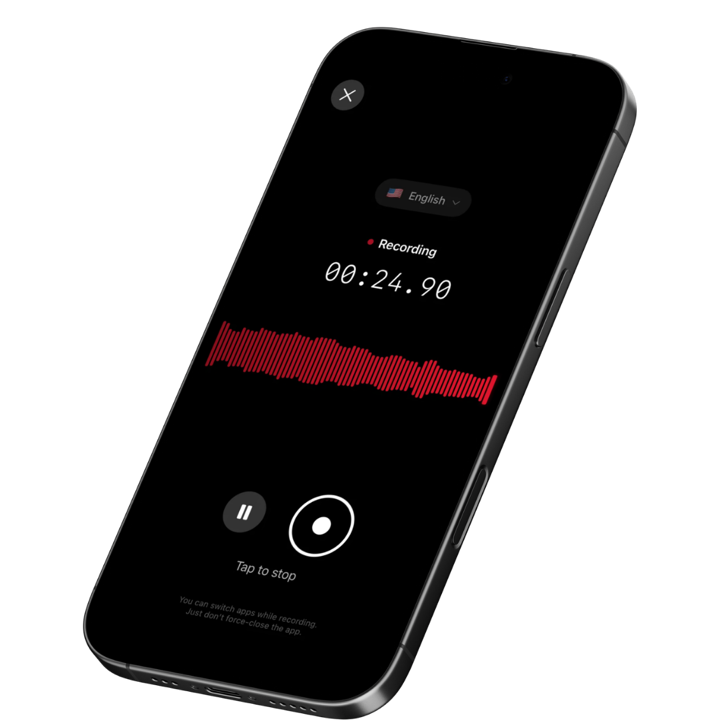
Speakwise is an iPhone app that records in-person conversations, meetings, lectures, and interviews with one tap, then turns the recording into a written transcript and an AI summary with action items. Instead of replaying an hour of audio, you read a summary at your own silent reading speed, and the full transcript shows who said what if you need the exact wording. Speaker identification is not included in every plan. When you start your free trial, pick the plan that includes it. Speakwise reaches 95%+ accuracy in optimal audio conditions and 92%+ in noisy rooms with several speakers, works in 100+ languages, and keeps recording for up to 5 hours, so one recording can cover a full lecture or a long client meeting. For more on why people capture ideas by voice in the first place, see our voice notes statistics.
Try Speakwise free for 7 days ($0.00). After that, it starts at $69.99 per year, which is about $5.83 a month, billed yearly. Prices shown are for the US and can differ by country.Download Speakwise from the App Store and get a transcript and summary you can read instead of replaying the recording.
Try Speakwise free for 7 days
Available on the App Store | iOS Optimized

🎯 4.9★ App Store Rating | 📱 Built for iOS
