Task-Switching Cost Statistics: 16 Productivity Findings
TL;DR
Task-switching cost statistics show shifting tasks can cost up to 40% of productive time (APA). Full focus recovery after an interruption takes about 23 minutes (Gloria Mark, UC Irvine). Speakwise writes the meeting summary on iPhone, so you stop task-switching, with a 7-day free trial.
Used by recruiters, executives, consultants, and more.
Task-Switching Cost Statistics: 16 Productivity Findings for 2027
Task-switching cost statistics describe a structural feature of modern knowledge work, not a personal failing. Open chat channels, meeting-heavy calendars, and the social pressure to answer fast all reward switching over staying on one thing. This post covers 16 research-backed numbers on the time lost, the errors, the recovery periods, and the economics behind the cost.
1. Task Switching Can Cost Up to 40% of Productive Time
Research by psychologist David Meyer, discussed in materials published by the American Psychological Association, found that shifting between tasks can consume as much as 40% of a person's productive time. The figure accounts for two components: the explicit time lost to switching itself (loading new task context, scanning for where you left off) and the implicit cost of reduced performance during the "warm-up" period before full cognitive engagement is restored in the new task. Both components recur with every switch. In an 8-hour day, a 40% loss means approximately 3.2 hours of diminished-output work that would have been full-output single-task work.
Source: American Psychological Association - Multitasking: Switching Costs
2. Full Focus Recovery After Interruption Takes 23 Minutes and 15 Seconds
Gloria Mark of the University of California, Irvine, found through direct workplace observation that it takes an average of 23 minutes and 15 seconds for a worker to fully return to a task after a significant interruption. Crucially, the recovery is not linear: workers typically drift through two or three unrelated tasks before eventually finding their way back to the original. The 23-minute clock resets with each new interruption, which means a worker interrupted three times per hour may spend the entire hour in a state of partial focus, never reaching the sustained engagement required for complex output. For our context switching breakdown, the relationship between interruption frequency and cumulative recovery time is similarly documented.
Source: UC Irvine / Fast Company - Worker, Interrupted: The Cost of Task Switching
3. Workers Switch Between Digital Apps More Than 1,200 Times Per Day
A 2022 study published in the Harvard Business Review found that the average knowledge worker toggles between applications and websites nearly 1,200 times per day. Each application switch imposes a context-loading cost: the cognitive state associated with the new environment must be retrieved and the previous state must be set aside. Across 1,200 switches, workers spend close to 4 hours per week - roughly 5 full working weeks per year, or about 9% of annual work time - in the reorientation state between meaningful task engagement. The figure has risen with the proliferation of collaboration tools that each require separate attention.
4. Toggling Between Apps Costs Each Knowledge Worker 9.5 Minutes Per Switch to Recover
A joint study by Qatalog and Cornell University found that it takes an average of 9.5 minutes to return to a productive workflow after switching to a different digital application. For workers toggling apps dozens of times per day, the cumulative reorientation time is substantial even at this shorter per-switch figure. The Qatalog/Cornell estimate reflects switches within a task thread (returning to a document after checking Slack, for example) rather than full task interruptions, which explains the shorter recovery time compared to Mark's 23-minute figure. Both figures represent real costs; they apply to different levels of interruption severity.
5. 45% of Workers Report That Too Many Apps Makes Them Less Productive
The Qatalog and Cornell survey also found that 45% of workers explicitly identified toggling between too many applications as a source of reduced productivity, and 43% reported that constant switching between tools and contexts is mentally exhausting. This is a direct worker-reported acknowledgment of the task-switching cost: not an inferred productivity loss from behavioral observation, but a majority-share self-report. Workers are not unaware of the problem. The barrier is structural: switching between tools is required by the workflow, not chosen for its own sake. Addressing the cost requires redesigning the environment, not just advising individuals to "batch" their attention.
6. Switching Tasks Results in More Errors Than Repeating the Same Task
Research by Joshua Rubinstein, David Meyer, and Jeffrey Evans established that switching tasks results in significantly more errors than continuing within the same task. The error rate rises because each switch requires the brain to reconfigure its goal representations, filter out residual activation from the prior task, and load the rules and context of the new one. During this configuration period, the cognitive system is operating on incomplete setup, making it vulnerable to applying the wrong rules or missing contextual constraints. In high-stakes professional work - medical decisions, financial modeling, legal drafting, code review - this elevated error rate during switching periods carries concrete downstream costs.
Source: American Psychological Association - Multitasking: Switching Costs
7. A 2024 Microsoft Study Found 26% Higher Stress Among Workers With More Digital Interruptions
Microsoft's research on hybrid work patterns found that employees who experienced more frequent digital interruptions reported 26% higher stress levels and lower overall job satisfaction compared to those with more protected focus time. The stress elevation is not purely psychological: sustained context switching activates the sympathetic nervous system in a way that single-task work does not, because each switch involves an element of uncertainty (what state was I in? what is required of me now?) that the brain processes as mild threat. Chronic low-grade activation of this threat response produces the fatigue and irritability that many professionals attribute to long hours but is actually a consequence of interruption frequency.
Source: Microsoft - AI at Work Is Here. Now Comes the Hard Part
8. 20 Minutes of Repeated Interruptions Significantly Raises Stress, Frustration, and Workload
A UC Irvine study found that after only 20 minutes of interruptions recurring at regular intervals, participants reported significantly higher stress, frustration, workload, effort, and time pressure compared to an uninterrupted control condition. The effect built quickly rather than accumulating slowly - 20 minutes was sufficient to produce measurable psychological impact. For professionals whose interruption patterns run across full workdays (275 interruptions daily according to some estimates), the cumulative stress load is not a slow background burn but a continuous activation that degrades cognitive performance and emotional regulation simultaneously.
Source: ResearchGate - The cost of interrupted work: More speed and stress
9. Heavy Multitasking Reduces IQ by Up to 10 Points Temporarily
Research cited in cognitive productivity literature found that sustained heavy multitasking produces a temporary reduction in measured IQ of up to 10 points - a larger decrement than losing a full night of sleep. The mechanism involves working memory saturation: when the cognitive system is simultaneously managing context for multiple task threads, the capacity available for any single task falls substantially below the single-task ceiling. For professionals making decisions, drafting communications, or analyzing data during meeting-heavy days, this temporary IQ floor is not a worst-case scenario - it is the baseline condition. The note-taking and meeting productivity research collected in our note-taking productivity statistics documents similar patterns around meeting cognitive load.
Source: IOSM - Attention is Today's Productivity Gap
10. Task Switching Interruptions Account for 28% of the Average Knowledge Worker's Day
Research quantifying the time burden of interruptions and their recovery costs found that unnecessary interruptions and the recovery time they require consume approximately 28% of the average knowledge worker's day - the equivalent of 2.1 hours of lost productivity every single working day. At an annualized rate, this represents around 500 hours of diminished or lost productivity per employee per year. For an organization with 200 knowledge workers, the aggregate waste runs to 100,000 hours annually - equivalent to the full-time output of roughly 50 additional employees who never produce anything.
Source: Pieces.app - The cost of context switching: how task juggling is destroying productivity
11. Software Developers Lose 15 to 30 Minutes of Productive Coding Per Context Switch
A 2017 study on the impact of task switching and work interruptions on software development found that developers lose between 15 and 30 minutes of productive coding time per context switch. Software development is a domain requiring particularly deep working memory engagement - holding multiple interconnected code states simultaneously - making context-loading costs especially high. A developer interrupted four times in a day loses 60 to 120 minutes of potential coding output before accounting for the meeting time itself. The finding has been widely cited in engineering productivity discussions and informs team practices like "maker's schedule" protection and asynchronous communication defaults.
12. Lost Productivity From Interruptions Costs the U.S. Economy an Estimated $588 Billion Annually
Extrapolating from the 28 billion lost person-hours per year generated by unnecessary interruptions across the U.S. workforce, the estimated annual economic cost of task-switching-driven productivity loss reaches approximately $588 billion. The figure makes task switching one of the most expensive unaddressed organizational design problems in the modern economy. Unlike capital expenditure or labor cost, the loss is invisible in standard accounting: it shows up not as an expense line but as the gap between what professionals actually produce and what they could produce with better-protected focus time.
Source: Pieces.app - The cost of context switching: how task juggling is destroying productivity
13. Atlassian Estimates Task Switching Costs the Global Economy Approximately $450 Billion Annually
Atlassian's research estimated that task switching costs the global economy approximately $450 billion annually in lost productivity. The figure is consistent in order of magnitude with U.S.-focused estimates and captures the global scope of a problem that affects every knowledge-work sector in every geography. Atlassian's own research also found that 60% of work time is spent on "work about work" - coordination tasks, application switching, status meetings, and information searching - rather than skilled output, with task switching as the mechanism through which that coordination time imposes its heaviest cost.
Source: Atlassian - Workplace Woes: Meetings
14. The Average Knowledge Worker Is Interrupted Every 11 Minutes During the Workday
Research on workplace interruption patterns finds that the average knowledge worker is interrupted every 11 minutes. Set against the 23-minute recovery time to full focus, this creates an arithmetic impossibility: workers are interrupted again, on average, before they have had time to fully recover from the prior interruption. The practical consequence is that most knowledge workers operate below full cognitive engagement for most of the workday - not because they lack focus capacity, but because the interruption cadence structurally prevents recovery. This is not a personal failure of the individuals; it is a design failure of the communication systems and norms around them.
Source: Productivity Report - How Much Time Do We Lose Task-Switching?
15. A Stanford Study Found Heavy Multitaskers Are More Distractible and Have Weaker Cognitive Control
A Stanford University study by Eyal Ophir, Clifford Nass, and Anthony Wagner found that heavy media multitaskers performed worse than light multitaskers on all cognitive control tasks administered, including attention filtering (suppressing irrelevant stimuli), task switching (moving between mental sets efficiently), and working memory (holding and updating information). Counterintuitively, the group that switched between media most frequently was the least skilled at switching. The explanation is that frequent switching trains the brain to scan broadly rather than filter selectively, making it harder to maintain deep focus when it is needed. Chronic task switching may, over time, reduce the very cognitive capacity required to manage it.
Source: Stanford / Asana - Multitasking: Why It Fails at Work
16. Reducing Meetings by 40% Produced 71% Higher Productivity in a Controlled Study
A study by Benjamin Laker reported by Harvard Business Review found that employee productivity was 71% higher and engagement 55% better when meeting time was reduced by 40%. The mechanism connecting meeting reduction to productivity gain is largely task-switching cost avoidance: fewer meetings mean fewer forced context breaks, shorter recovery periods, and more sustained cognitive engagement with primary work. The size of the effect (71% productivity increase from a 40% meeting reduction) reflects how heavily task-switching overhead was suppressing output in the baseline condition.
Source: Harvard Business Review / Axios HQ - How orgs like Shopify are reducing meetings to save millions
What the Data Reveals About Task-Switching Costs
Taken together, these statistics describe a workplace productivity crisis with a structural rather than individual cause. The 40% productivity loss from task switching, the 23-minute recovery time from interruptions, the 1,200 daily app switches, and the 28% of the day lost to interruptions all point to the same conclusion: the cognitive cost of modern work's fragmentation is enormous, and it is imposed on workers by the design of their environments rather than by any choice they make.
The error-rate findings add a quality dimension to the time dimension. Task switching does not just consume hours that could have been spent working. It degrades the output produced during the hours that do count as work. Decisions made, code written, documents drafted, and analyses completed during high-interruption periods carry a systematically higher error burden than the same tasks completed in protected focus time.
The trajectory is challenging. The average focused session duration has fallen 9% since 2023. Application ecosystems continue to proliferate, adding more switching points. Meeting hours per employee are growing. Without deliberate organizational redesign - protected focus blocks, asynchronous communication defaults, meeting reduction, and structured handoff protocols that reduce context-reconstruction costs - the gap between knowledge workers' potential output and their actual output will continue to widen.
Task-switching cost is the most expensive unaddressed design problem in the modern workplace, and the data makes the cost of inaction concrete.
Cut the Cognitive Cost of Meeting Context Switching
One of the highest-frequency task-switching triggers in most professionals' days is the meeting. Each meeting requires loading a new context (who is involved, what was decided last time, what the goal is today), and each meeting exit requires reloading the prior task context. The cognitive cost is real and measurable.
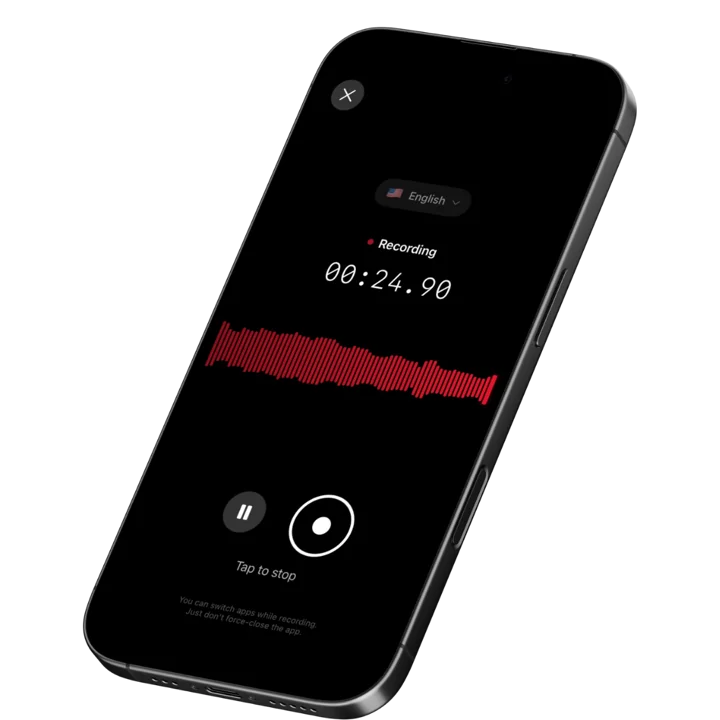
Speakwise turns your iPhone into an AI meeting assistant. One-tap or AirPods hands-free recording captures in-person conversations, then produces summaries, accurate transcripts in 100+ languages, and automatic action item extraction. With a full transcript and summary available immediately after a meeting, context reconstruction - the most expensive part of post-meeting task switching - drops from a minutes-long cognitive exercise to a brief scan.
For consultants, sales professionals, product managers, and anyone navigating a dense meeting calendar, Speakwise reduces the switching cost on both sides of every meeting: faster context loading before, faster re-engagement after.
Download Speakwise on the App Store and recover the focus time that meeting context-switching currently consumes.
Speakwise holds a 4.9-star App Store rating with thousands of installs.
Download Speakwise on the App Store

🎯 4.9★ App Store Rating | 📱 Built for iOS
