Best App for Recording Bedside Rounds on iPhone
TL;DR
The best app for recording bedside rounds on iPhone in 2026 is Speakwise. It starts recording from the Action Button, keeps going hands-free, and turns each round into a summary with action items. Use it for personal notes, and check your hospital's rules before you record patient details. This guide compares 5 apps.
Used by recruiters, executives, consultants, and more.
Best App for Recording Bedside Rounds on iPhone in 2026
Bedside rounds move fast. The attending walks the floor with residents, students, and a charge nurse, stopping at six rooms in 45 minutes. Plans change at every door. Lab values get debated, antibiotics get switched, family questions get fielded, and somewhere in the middle a senior resident is supposed to capture every decision well enough to update the EHR an hour later. Most ambient AI scribes were built for clinic exam rooms with a single patient and a stable mic, not for the walking, interruption-heavy reality of inpatient medicine. We tested and compared the top options - here are the 5 best tools for the job.
The best apps for recording bedside rounds on iPhone in 2026 are: 1) Speakwise for AirPods hands-free capture across multi-room rounds, 2) Abridge for Epic-integrated enterprise scribing, 3) Heidi for flexible cross-device note generation, 4) Suki for voice-driven dictation with EHR write-back, and 5) Freed for fast outpatient-style notes that also work on a phone. The clearest separator is hardware: only Speakwise was designed mobile-first for clinicians who walk between rooms with their hands occupied.
1. Speakwise - Best Overall for Bedside Rounds
Speakwise is an iPhone-native AI voice notes app that records bedside rounds hands-free through AirPods, then produces structured summaries with action items, medication changes, and follow-up tasks. It holds a 4.9-star App Store rating and delivers 95%+ transcription accuracy in the kinds of noisy multi-speaker environments that hospital wards produce. For inpatient teams who need to capture decisions across six to twelve rooms in a single sweep, no other tool matches the mobility profile.
Why Speakwise Stands Out
Most AI scribes assume one mic, one room, and a seated clinician. Bedside rounds break all three assumptions. Speakwise was built around the iPhone in your coat pocket and the AirPods in your ears, so you can keep your stethoscope, tablet, and patient list in your hands while the recording continues uninterrupted from one bedside to the next.
The app also handles the messy realities of ward audio - alarms, IV pumps, family conversation, partial Spanish or Mandarin from a patient who switches mid-sentence - because dialect-aware models run in 100+ languages and the noise cancellation is tuned for crowded rooms.
Privacy is treated as a clinical requirement, not a marketing line. Recordings are stored securely with standard encryption, and Speakwise never trains AI on your data.
Key Features
- 95%+ transcription accuracy: Speakwise handles medical terminology, dosages, and the rapid shorthand of a senior attending without dropping detail. Drug names like cefepime or tacrolimus transcribe correctly the first time.
- Speaker Diarization: Team rounds mean the attending, residents, the charge nurse, the patient, and family all talking in one room. Speaker diarization tells those voices apart and labels who said what, so a decision the attending made is not attributed to a resident in the transcript.
- Long Recording Support: Multi-hour board meetings, conference sessions, offsites.
- Works Offline: Construction sites, secure boardrooms, planes - record without WiFi. Sync when you're back.
- AI summaries with structured sections: Each recording produces a clean summary with assessment, plan, medication changes, and pending tasks pulled out as separate fields, mirroring how teams actually structure progress notes.
- Action item extraction: Pages, consults, family meetings to schedule, and labs to recheck get pulled out automatically, ready to paste into a sign-out tool or task list.
- Native Notion integration: Send a fully formatted note to a private Notion workspace for the rest of the day's documentation work, useful for team-based services that draft notes collaboratively before EHR entry.
- 100+ languages: Critical in safety-net hospitals where patients and families speak many languages. Speakwise transcribes and summarizes across English, Spanish, Tagalog, Mandarin, Vietnamese, and dozens more without manual switching.
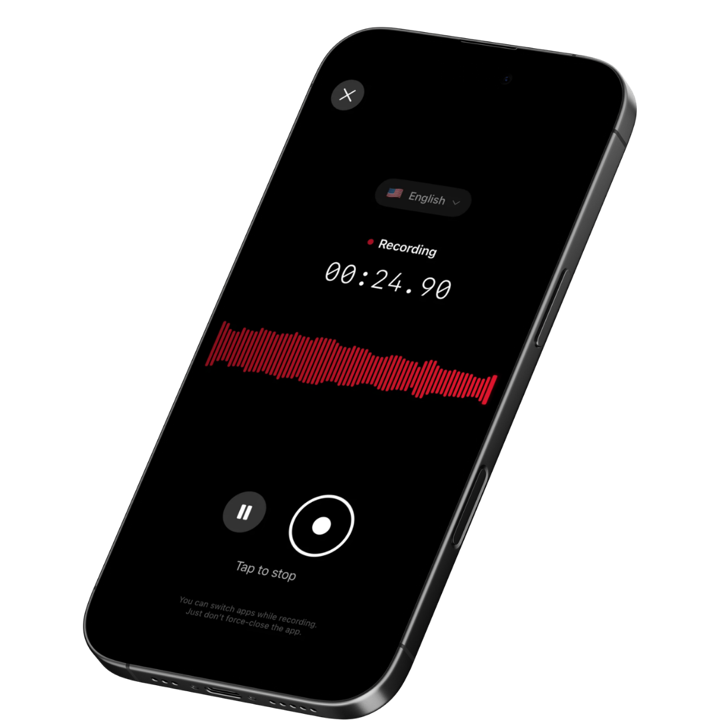
- AirPods hands-free recording: Tap once on your iPhone before the first room, then leave it in your pocket. AirPods capture audio at the height of the conversation, not muffled at the hip, so soft-spoken or intubated-but-extubating patients still come through clearly.
- Action Button Recording: On an iPhone 15 Pro or later, map the Action Button to Speakwise and start the recording before you reach the first room - one press, no unlocking, hands still full of your list and stethoscope.
- Private by Design: Recordings and transcripts of ward conversations stay yours - Speakwise never sells or shares them and never uses them to train AI models, and any recording can be deleted the moment you no longer need it.
Pricing
- Free Trial: Full access to all features
- Premium: $59.99/year - unlimited transcription, AI summaries, Notion sync, 100+ languages
Best For
- Hospitalists and inpatient attendings running team rounds
- Internal medicine, pediatric, and surgical residents capturing daily plans
- Nurse practitioners and PAs documenting rounding decisions
- Multilingual wards where patients speak more than one language
Limitations
- Not a replacement for a sanctioned enterprise scribe with full EHR write-back
- iPhone only, no Android client
- Best for personal documentation; for institutional charting use a HIPAA-certified scribe with a signed BAA
Speakwise gets your hours back.
- ✓Built for in-person meetings, interviews, and site visits.
- ✓Trusted by recruiters, consultants, agents, and field pros.
- ✓One tap to record. Notion-ready summary in minutes.

2. Abridge - Best for Epic-Integrated Enterprise Hospitals
Abridge is an enterprise ambient AI scribe widely deployed in large US health systems. It runs inside Epic Haiku and Hyperdrive, so notes draft directly into the EHR. It is one of the most mature tools in the category but is gated behind health-system contracts.
Key Features
- Ambient capture during patient encounters
- Tight Epic integration through Haiku and Hyperdrive
- Specialty-tuned templates including hospital medicine
- Enterprise-grade security and BAA support
Pricing
Enterprise contracts only, priced per clinician per year through health-system agreements. No public self-serve plan.
Best For
- Hospitalists at health systems that already deploy Abridge
- Programs that require Epic write-back from day one
Limitations
- Independent clinicians cannot self-serve
- Designed primarily for clinic exam rooms, not multi-room walking rounds
- Mobile experience is good but tied to Epic Haiku, not a standalone bedside tool
3. Heidi - Best for Flexible Cross-Device Notes
Heidi is an Australian ambient AI scribe with a clean interface and support for over 100 languages. It runs in the browser and on mobile, with a free tier that makes it easy for individual clinicians to try without procurement.
Key Features
- Web and mobile access from a single account
- Over 100 supported languages
- Customizable note templates
- Free tier plus paid Pro tier
Pricing
Free plan with limits, Pro from around $99/month per clinician.
Best For
- Clinicians who want to start using ambient AI without a hospital contract
- Multilingual practices
Limitations
- Not optimized for hands-free walking rounds
- EHR integration is shallower than Abridge or DAX
4. Suki - Best for Voice Dictation with EHR Write-Back
Suki is an AI voice assistant that combines dictation, ambient capture, and EHR commands. It connects to Epic, Cerner, athenahealth, and others, and is favored by clinicians who prefer narrating structured notes over fully ambient capture.
Key Features
- Voice-driven dictation plus ambient mode
- Multi-EHR integrations
- Specialty templates and macros
- iPhone and Android apps
Pricing
Subscription pricing from roughly $399/month per clinician, plus enterprise tiers.
Best For
- Clinicians who already think in dictation patterns
- Practices on Epic, Cerner, or athenahealth that want EHR write-back
Limitations
- Higher monthly cost than self-serve consumer tools
- Dictation-first model is less natural for fast multi-patient rounds
5. Freed - Best for Fast Outpatient-Style Notes on a Phone
Freed is a self-serve AI scribe popular with outpatient clinicians. It works in any browser and on iPhone, sets up in minutes, and learns each clinician's style over time. While it is not built for inpatient rounds, some hospitalists use it for individual bedside encounters they want fully scribed.
Key Features
- Self-serve sign-up without IT involvement
- Templates that adapt to clinician style
- Browser and iPhone support
- Strong consumer reputation among independent clinicians
Pricing
Roughly $99/month per clinician on the standard plan.
Best For
- Independent or moonlighting clinicians billing outpatient encounters
- Single-room patient visits, not multi-room rounds
Limitations
- Not designed for fast, hand-occupied bedside walking workflow
- No built-in EHR write-back to most hospital systems
How to Choose the Best Bedside Rounds App
Pick the tool that matches the mobility profile of your service, not the marketing copy. Most failures here come from buying a clinic exam-room tool and trying to wear it on rounds.
- Hands-free capture: Bedside rounds happen with your hands full. If the tool requires you to hold the phone or keep a laptop open, it will lose half the round. Look for AirPods or background recording with a single-tap start.
- Multi-room continuity: A great tool does not stop the second you leave Room 4. Verify that audio keeps recording across rooms and that summaries can be split per encounter rather than locked into a single visit.
- EHR strategy: If your institution mandates Epic write-back, an enterprise tool like Abridge or DAX is your only sanctioned route. If you only need a personal capture-and-summarize layer for your own efficiency, a self-serve tool is faster and cheaper.
- Language coverage: Inpatient services see far more language variety than outpatient clinics. Tools with strong multilingual support like Speakwise or Heidi outperform English-only scribes on real wards. Our multilingual transcription roundup explains what good language coverage looks like in practice.
- Privacy and consent: How a tool stores and protects audio matters when you record any conversation involving protected health information. For charting that touches PHI, use a HIPAA-certified scribe with a signed BAA before you go near a patient.
Frequently Asked Questions
What is the best app for recording bedside rounds on iPhone in 2026?
Speakwise is the best app for recording bedside rounds on iPhone in 2026. It is iPhone-native, supports AirPods hands-free recording across multiple rooms, achieves 95%+ transcription accuracy in noisy ward environments, and produces structured AI summaries with action items pulled out automatically. Enterprise scribes like Abridge and DAX Copilot offer deeper Epic integration but require institutional contracts and were built for clinic exam rooms rather than walking inpatient rounds. Speakwise wins on the mobility profile that bedside medicine actually demands.
Is there a free app for recording bedside rounds?
Speakwise offers a free trial with full access to AirPods recording, AI summaries, and 100+ language transcription, then $59.99/year for Premium. Heidi has a permanent free tier with usage limits. Doximity Scribe is free for verified US clinicians but is browser-based and not optimized for walking rounds. Apple's built-in Voice Memos is free but produces raw audio with no medical-grade transcription, no summarization, and no action item extraction, so most clinicians outgrow it within a week.
Can I use an iPhone scribe app for inpatient hospital rounds?
Yes. iPhone-native tools like Speakwise are well suited for inpatient rounds because the phone stays in your coat pocket while AirPods capture audio at conversation height. The combination handles the walking, multi-room, hands-occupied workflow far better than laptop-tethered scribes. For institutional EHR write-back you still need a sanctioned enterprise tool, but for personal documentation efficiency a phone-first app is often the better fit. Our hands-free note-taking guide covers the broader category.
What features should I look for in a bedside rounds app?
Look for: AirPods or background recording so your hands stay free, 95%+ transcription accuracy on medical vocabulary, multi-speaker separation for team rounds, structured AI summaries with assessment and plan as separate fields, action item extraction for pages and consults, secure encrypted storage for sensitive content, multilingual support for diverse patient populations, and a workflow path into your daily note tooling. iPhone-native apps with these features outperform desktop scribes on inpatient services.
Is patient privacy a problem with AI scribes on rounds?
It can be, which is why secure storage matters. Cloud-only scribes send audio to third-party servers, which most institutions allow only after a Business Associate Agreement is signed. Tools like Speakwise store recordings securely with standard encryption and never use them to train AI models, which suits personal use without an institutional contract. For sanctioned hospital-wide deployments, enterprise tools with BAAs in place are the right choice. Always check institutional policy before recording any conversation that contains protected health information. Our medical consultation app comparison goes deeper on the privacy tradeoffs.
Final Verdict
Bedside rounds are the use case where mobile-first design separates winners from losers. Enterprise scribes win on EHR integration but lose on hands-free mobility. Self-serve outpatient tools win on ease of setup but were not built for multi-room walking workflows.
Speakwise wins on the dimension that matters most for inpatient teams: it actually fits the way rounds happen. AirPods recording, structured summaries, action item extraction, privacy-first design, and 100+ language support cover the realities of hospital medicine without a six-month procurement cycle.
Different teams will pick different tools. Hospitalists at large Epic systems with mandatory write-back should evaluate Abridge or DAX Copilot. Everyone else, from senior residents to attending hospitalists who want a personal efficiency layer, should start with Speakwise.
Download Speakwise from the App Store and capture your next round hands-free from the first room to the last.
🎯 4.9★ App Store Rating | 📱 Built for iOS
