Best App for Recording In-Person Patient Visits
Used by recruiters, executives, consultants, and more.
Best App for Recording In-Person Patient Visits in 2026
The hardest patient visit to chart is not the telehealth one. It is the in-person 14-minute follow-up where a patient brings up three new symptoms, you hand-write a quick scribble, walk to a workstation, and try to reconstruct what they said. In-person visits are why ambient AI scribes exist, and the iPhone in your white coat pocket is the easiest capture device. We tested and compared the top options - here are the 6 best apps for recording in-person patient visits.
The best apps for recording in-person patient visits in 2026 are: 1) Speakwise for hands-free iPhone capture with secure, encrypted storage, 2) Freed AI for solo SOAP-note charting, 3) Heidi Health for multilingual ambient scribing, 4) Abridge for enterprise EHR-integrated charting, 5) Suki AI for voice-driven EHR control, and 6) DAX Copilot for hospital-scale deployments. Speakwise is the personal capture layer. Freed and Heidi are the dedicated charting scribes. Most doctors benefit from running both.
1. Speakwise - Best Personal Capture for In-Person Visits
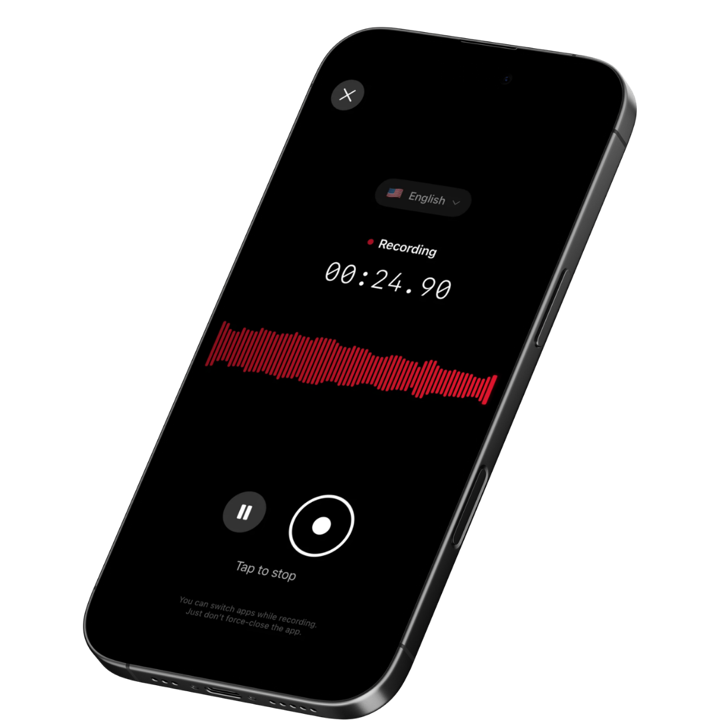
Speakwise is an iPhone-native voice notes and meeting transcription app built for fast, hands-free in-person capture. Tap once, AirPod stem, or Apple Watch shortcut to start. Get a 95%+ accurate transcript, AI summary with action items, and 100+ language support. Speakwise carries a 4.9-star App Store rating and stores recordings securely with standard encryption.
Why Speakwise Stands Out
Most ambient AI scribes are built for one thing: turning a 15-minute encounter into a SOAP note inside the EHR. That is genuinely useful, but it is not the whole job. In-person visits are bracketed by 30-second moments before, during, and after that the scribe never captures: the differential you walked into the room with, the family member's quick comment in the hallway, the multilingual aside, the teaching point during rounds. Our guide to recording discharge instructions covers that after-visit moment in more detail.
Speakwise covers those moments. The same hands-free capture pattern from our in-person AI meeting notes guide applies cleanly to bedside and exam-room work, and the iPhone-only setup mirrors what we recommend in our iPhone meeting recorder roundup.
Secure, standard-encrypted storage is a real differentiator for clinical use. For personal memos and case-thinking, recordings are stored securely with standard encryption, and Speakwise never trains AI on your recordings. That is a strong privacy posture for non-charting work. For charting that becomes part of the medical record, use a HIPAA-certified scribe with a signed BAA - Speakwise is the personal capture layer that sits alongside it. The AirPods workflow is the closest you can get to a wearable scribe without separate hardware, and several of our readers have noted it works well alongside the hands-free note-taking patterns we covered earlier.
Key Features
- 95%+ transcription accuracy: Tested across noisy clinic hallways, parking garages, and quiet offices. Medical jargon is handled well by large-model speech recognition, though it is not specialty-tuned the way Dragon Medical is for radiology or cardiology.
- Long Recording Support: Multi-hour board meetings, conference sessions, offsites.
- Works Offline: Construction sites, secure boardrooms, planes - record without WiFi. Sync when you're back.
- AI summaries with action items: Each recording is auto-summarized with key points, decisions, and a 94% accurate action-item list. A 4-minute differential becomes a 6-bullet plan you can paste anywhere.
- 100+ languages with auto-detection: Multilingual physicians and clinics serving diverse patients benefit from automatic language detection, including switching mid-recording. Useful for the in-person visits where a translator is not available, with broader patterns in our multilingual transcription roundup.
- Native Notion integration: Recordings sync with summary and transcript to your Notion database. Ideal for academic medicine, residency teaching files, and research-active clinicians who already work in Notion.
- One-tap and AirPods recording: Start a memo with a single tap, AirPod stem, or Apple Watch shortcut. No phone unlock, no app launch. Designed for the 20-second windows between in-person visits when most clinical thinking actually happens.
Pricing
- Free Trial: Full access to all features
- Premium: $59.99/year - unlimited transcription, AI summaries, Notion sync, 100+ languages
Best For
- Doctors capturing personal memos before, during, or after in-person visits
- Multilingual physicians and global health workers
- Researchers and teaching attendings who keep notes in Notion
Limitations
- Not a HIPAA-certified EHR scribe. For in-room patient charting that pushes to Epic, use a dedicated scribe like Freed AI.
- iPhone only. Android-using clinicians need a different tool.
- No specialty-specific medical vocabulary tuning out of the box.
Speakwise gets your hours back.
- ✓Built for in-person meetings, interviews, and site visits.
- ✓Trusted by recruiters, consultants, agents, and field pros.
- ✓One tap to record. Notion-ready summary in minutes.

2. Freed AI - Best for Solo SOAP-Note Charting
Freed AI is an ambient AI medical scribe trusted by 25,000+ clinicians. It records the in-person visit on iPhone or desktop, generates structured SOAP notes in seconds, suggests ICD-10 codes, and pushes directly to your EHR. HIPAA and SOC 2 compliant with BAA at every paid tier.
Key Features
- Ambient iPhone recording during the visit
- SOAP notes and ICD-10 codes generated automatically
- Direct EHR push for major systems
- Consistent note style across web and mobile
Pricing
Starter $39/month for 40 notes (annual). Core $79/month unlimited. Premier $119/month.
Best For
- Solo primary care and small private practice
- Clinicians who want SOAP notes generated end-to-end
Limitations
- Built for full visits, not 30-second hallway memos
- Less useful for off-EHR thinking and research
3. Heidi Health - Best Multilingual Ambient Scribe
Heidi Health is an ambient AI scribe built for international and multilingual clinicians. It supports 110+ languages, ships customizable templates beyond SOAP, and recently added Heidi Evidence (citation-backed clinical decision support) and Heidi Comms (patient communications). HIPAA compliant, SOC 2 Type II, no audio retention after transcription.
Key Features
- 110+ languages, including code-switching
- Customizable templates for every specialty
- Generous free tier for individual clinicians
- Strong international coverage (UK, AU, EU)
Pricing
Free tier available. Paid plans around $150/user/month yearly.
Best For
- Multilingual or international practices
- Specialties needing custom note templates
Limitations
- Premium plans are among the more expensive options
- Heavier setup than a personal recorder
4. Abridge - Best Enterprise EHR-Integrated Scribe
Abridge is an enterprise ambient AI scribe used by major US health systems. It earned Best in KLAS for Ambient AI in 2025 and 2026. It generates clinical notes, billing codes, and patient after-visit summaries in lay language, with deep Epic and Cerner integration.
Key Features
- Deep Epic and Cerner integration
- Patient-facing after-visit summaries in plain language
- HIPAA, SOC 2, and HITRUST certifications
- Strong specialty coverage
Pricing
~$250/month per provider, enterprise contracts. No self-serve.
Best For
- Hospital systems and large multi-specialty groups
- Clinicians who want patient-facing after-visit summaries
Limitations
- No solo or small-practice path
- Long sales and onboarding cycles
5. Suki AI - Best Voice-Driven EHR Control
Suki AI is a voice-first ambient documentation assistant. Beyond transcribing the in-person visit, it accepts voice commands for ordering, charting, navigation, and clinical Q&A. It is positioned for clinicians who want to drive the EHR with their voice rather than just dictate into it.
Key Features
- Ambient scribing plus voice-command EHR control
- Structured note generation
- Specialty templates
- Major EHR integrations
Pricing
Custom enterprise quotes. Generally premium pricing per provider.
Best For
- Clinicians who want voice control of the EHR, not just transcription
- Specialties with heavy order entry
Limitations
- Quote-based pricing
- Heavier learning curve than pure scribes
6. DAX Copilot - Best for Hospital-Scale Deployments
DAX Copilot (Microsoft/Nuance) is the enterprise ambient documentation tool with the deepest install base in US hospitals. It records via the PowerMic Mobile iPhone app and generates structured clinical notes inside Epic. Pricing is among the highest in the category, but the Epic integration depth is unmatched.
Key Features
- iPhone capture via PowerMic Mobile
- Deep Epic integration
- Specialty vocabulary
- Hospital-grade infrastructure
Pricing
~$369-830+/month per clinician, ~$600/month average. Setup fees apply.
Best For
- Large hospital systems on Epic
- Specialties with dense vocabulary
Limitations
- iPhone only for mobile capture (Android locked out)
- Highest cost in the category
- Long enterprise procurement cycle
How to Choose the Best In-Person Patient Visit App
Match the tool to the moment. In-person visits look the same from outside but vary widely in capture needs.
- Full visit charting vs. surrounding memos: If you want a SOAP note pushed to the EHR after every visit, use Freed, Heidi, Abridge, Suki, or DAX. If you want personal memos around the visit, use Speakwise. Most doctors need both layers.
- HIPAA and BAA: Any tool that holds in-person patient-visit audio must be HIPAA compliant with a signed Business Associate Agreement. Confirm the BAA explicitly before recording any visit.
- Background noise tolerance: In-person visits happen in real clinic acoustics, with door slams, hallway voices, and equipment beeps. Test apps in your actual rooms before standardizing on one.
- EHR integration depth: For Epic and Cerner shops, Abridge and DAX have the deepest integrations. For smaller EHRs, Freed and Heidi cover wide ground.
- Consent and patient experience: Recording in person feels different to the patient than recording a phone visit. Pick a tool with a clear consent flow and visible recording indicator. Patients accept recording most easily when they can see what is happening.
Frequently Asked Questions
What is the best app for recording in-person patient visits in 2026?
For full ambient SOAP-note charting of in-person visits, Freed AI is the strongest solo-friendly option. Heidi Health wins for multilingual or international practices, and Abridge or DAX for large hospital systems. For personal memos before, during, or after in-person visits, Speakwise is the best iPhone tool because of its hands-free AirPods capture, secure encrypted storage, and AI summaries. Most doctors benefit from running both: a HIPAA-certified scribe for the chart and Speakwise for the surrounding clinical thinking.
Is recording in-person patient visits HIPAA compliant?
In-person patient-visit recordings are PHI, so the tool must be HIPAA compliant with a signed Business Associate Agreement and the recording must be obtained with patient consent. Freed, Heidi, Abridge, Suki, and DAX all sign BAAs and ship explicit consent flows. Apple Voice Memos and consumer-tier general recorders do not meet this bar. For non-PHI personal memos, tools like Speakwise store recordings securely with standard encryption, and Speakwise never trains AI on your recordings, but they should not be used to record actual patient encounters for charting.
Do I need patient consent to record in-person visits?
Yes. Even in one-party consent states, recording a patient encounter without their knowledge violates clinical ethics, hospital policy, and most professional society guidelines. Every reputable ambient AI scribe (Freed, Heidi, Abridge, Suki, DAX) requires explicit patient consent and ships a brief disclosure script. Document consent in the chart, make it easy for the patient to decline or stop the recording, and confirm the recording light or indicator is visible. Patients overwhelmingly accept recording when it is offered transparently.
Can the iPhone microphone handle a real exam room?
Modern iPhones (12 and later) capture in-person voice cleanly across a typical 8x10 exam room. AirPods Pro 2 and AirPods 4 do even better thanks to beam-forming and noise cancellation. The harder cases are noisy waiting rooms, busy ED hallways, and ORs, where dedicated lavalier or wearable hardware (Plaud) outperforms the phone. For standard primary care, urgent care, and clinic visits, an iPhone with AirPods is enough for most scribes and for tools like Speakwise to hit 95%+ accuracy.
What features should I look for in an in-person patient visit recording app?
Look for: (1) HIPAA compliance with a signed BAA, (2) clear consent flow with visible recording indicator, (3) structured SOAP-note output, (4) ICD-10 and CPT code suggestions, (5) direct EHR push to your specific EHR, (6) strong noise cancellation in real exam-room conditions, and (7) reliable iPhone app, not just web. For personal memos around the visit, also prioritize hands-free recording, secure encrypted storage, and AI summaries with action items.
Final Verdict
Recording in-person patient visits is best handled as two layers, not one tool. A HIPAA-certified ambient scribe charts the visit. A fast personal voice-notes app captures everything around it: the prep, the differential, the multilingual aside, the teaching point, the after-visit reflection.
For the personal layer, Speakwise is the strongest option in 2026. iPhone-native, hands-free via AirPods, 100+ languages, and AI summaries with action items, all for $59.99/year. Pair it with Freed AI ($39-119/month) for solo charting, Heidi for multilingual practice, or Abridge/DAX for hospital settings.
Different practices will reasonably choose different scribes, but Speakwise is the clearest fit for the personal capture layer that sits next to whichever scribe you choose.
Download Speakwise from the App Store and capture the clinical thinking that surrounds every in-person patient visit you do.
🎯 4.9★ App Store Rating | 📱 Built for iOS
