Handoff Communication Statistics 2027: What Gets Lost
TL;DR
Handoff communication statistics for 2027 show information breaks down when work changes hands. A 2017 estimate ties failures to 50% to 80% of sentinel events (Patient Safety and Quality Healthcare). Speakwise turns a handoff into an iPhone transcript and summary, with a 7-day free trial.
 Speakwise - AI Note Taker
Never miss a key detail
- Smart summaries and action items.
- Speaker diarization labels who said what.
- Unlimited premium transcription.
- Auto-sync to Notion.
- Record offline, even with no signal.


Used by recruiters, executives, consultants, and more.
Handoff Communication Statistics 2027: What Gets Lost
Handoff communication statistics show how often information breaks down the moment work changes hands, from a nurse's shift change to a factory shift crew handing off the floor. The pattern repeats across hospitals, factories, and call centers, wherever one person passes a task to another. This post gathers 16 statistics on what gets lost in that handoff, and what helps.
Key Handoff Communication Statistics (2027)
- Communication failures contribute to an estimated 50% to 80% of hospital sentinel events, Dr. Christopher Landrigan, the physician who led the I-PASS handoff study, said in a 2017 interview (Patient Safety & Quality Healthcare).
- Communication breakdowns played a role in 30% of the 23,658 malpractice cases in CRICO's claims database that were filed from 2009 to 2013 (CRICO Strategies 2015 report).
- Medical errors fell 23% across 10,740 patient admissions after a standardized handoff program called I-PASS was introduced, a 2014 study found (Starmer et al., NEJM 2014).
- A 2007 review found that a discharge summary was ready for a patient's first follow-up visit in just 12% to 34% of cases across the studies it reviewed (Kripalani et al., JAMA 2007).
- In a 1994 study at one teaching hospital, a preventable adverse event was linked to coverage by a doctor from another team, with 6.1 times the odds (Petersen et al. 1994, Annals of Internal Medicine).
- In Zendesk's own CX Trends 2026 survey, 74% of customers said it is frustrating to repeat their story to different agents (Zendesk CX Trends 2026).
- A 2007 study of 50 handovers found that a structured protocol modeled on Formula 1 pit stops cut multi-error handoffs from 39% to 11.5% (Catchpole et al., 2007).
1. Communication failures contribute to an estimated 50% to 80% of sentinel events
A "sentinel event" is a patient safety incident that causes death or serious harm. You may have read that exactly 80% of these events trace back to a handoff. That precise figure does not appear in the Joint Commission's 2017 Sentinel Event Alert on hand-off communication. The alert calls inadequate hand-off communication a contributing factor in many sentinel events, but it gives no percentage for how many sentinel events trace back to a handoff specifically. The honest number is a range. Dr. Christopher Landrigan, the physician who led the landmark I-PASS handoff study, said in a 2017 interview that communication failures contribute to somewhere between 50% and 80% of sentinel events.
The range matters more than a single round number would. Even the low end, half of the most serious adverse events in U.S. hospitals, points to communication problems, and a handoff is one of the moments when communication can fail.
Source: Patient Safety & Quality Healthcare: Patient Handoffs: The Gap Where Mistakes Are Made
2. Communication breakdowns played a role in 30% of malpractice claims
CRICO Strategies, the patient safety analytics arm of a Harvard-affiliated malpractice insurer, studied 23,658 malpractice cases filed in the U.S. between 2009 and 2013. Communication breakdowns, not just clinical mistakes, played a role in 30% of them. The analysis covered surgery, general medicine, nursing, and obstetrics, and found communication problems across every setting it studied.
This was not a small side issue. Nearly a third of malpractice claims in the study had a communication failure attached. That often meant information one clinician had did not reach the clinician who needed it next, the same breakdown that happens at a handoff.
Source: CRICO Strategies: Malpractice Risks in Communication Failures (2015 report)
3. Communication failures were tied to 37% of the most severe malpractice cases
The same CRICO Strategies analysis found an even higher share of communication problems in the worst cases. Among malpractice claims involving high-severity patient injury, meaning the patient died or was left with serious, permanent harm, 37% were tied to a communication failure, compared with 30% of claims overall. Surgery, general medicine, nursing, and obstetrics all showed up among the affected specialties.
The pattern suggests that communication failures do not just cause minor mix-ups. They show up in a higher share of the worst cases (37%) than of all cases (30%). The report counts every kind of communication failure, not handoffs alone, but a handoff is one place where a failure like this can happen.
Source: CRICO Strategies: Malpractice Risks in Communication Failures (2015 report)
4. Communication failures cost $1.7 billion and were linked to 1,744 deaths
The same five-year CRICO Strategies analysis put a dollar figure and a death toll on communication failures: $1.7 billion in malpractice costs and 1,744 deaths. The study also found that electronic health records, which were supposed to help communication, sometimes made it worse, for example when a lab result never got flagged to the primary care provider.
These numbers only describe cases that reached a lawsuit, so they almost certainly undercount the true scale. Most communication failures never turn into a malpractice claim. They just mean a patient gets worse information, or no information, when their care changes hands.
Source: Healthcare Dive: How EMR Miscommunication Can Contribute to $1.7B in US Malpractice Claims
5. Medical errors fell 23% after a standardized handoff program
Researchers tested a standardized handoff program called I-PASS across 10,740 patient admissions at 9 pediatric residency programs. Medical errors fell by 23%, from 24.5 errors per 100 admissions before the program to 18.8 after it. I-PASS gives incoming and outgoing clinicians a shared format for a handoff, so fewer details get skipped under time pressure.
Six of the nine hospitals saw a significant drop in errors on their own. Residents using I-PASS did not spend more time on handoffs or lose time elsewhere in their workflow, so the improvement came without a tradeoff in speed.
6. Preventable adverse events fell 30% under the same handoff program
In the same I-PASS study, preventable adverse events, meaning harm that better care could have avoided, fell by 30%, from 4.7 events per 100 admissions to 3.3. That is a bigger drop than the 23% reduction in medical errors overall.
Nonpreventable adverse events, the ones that happen even with excellent care, did not change. That is a useful check: the improvement tracked the exact thing the program targeted, communication at the handoff.
7. A 2009 review kept just 46 of 2,590 search results
Researchers searched PubMed for English-language articles on physician handoffs in the United States, published between 1987 and June 2008, and found 2,590 articles. After a title review, 401 were read in detail, and 46 fit the review's rules for what to include, about 1 in 56. Most of that small set was newer: 33 of the 46, or 71.7%, were published between 2005 and 2008. Those 46 studies described 91 separate barriers to a good handoff and 140 strategies meant to fix them.
Only 6 studies measured whether a handoff strategy actually worked. The review's own conclusion was blunt: very little research had identified real best practices for physician handoffs, despite how often the topic comes up in patient safety discussions.
8. A 2007 review found hospital doctors directly reach a patient's regular doctor just 3% to 20% of the time
A 2007 review of 73 studies on communication between hospital-based physicians and primary care physicians found that direct contact, an actual conversation or call, happened in only 3% to 20% of cases across the studies that measured it. Most of the time, the primary care physician learns what happened in the hospital from a written summary instead, if one arrives at all.
That gap matters most at the moment a patient's care hands off from the hospital back to their regular doctor. A written note can cover the basics, but it cannot answer a follow-up question or flag a detail that only comes up in conversation.
9. The same 2007 review found a discharge summary is often missing at a patient's first follow-up visit
The same 2007 review of hospital-to-primary-care communication found that a discharge summary, the document meant to hand off a patient's hospital stay to their regular doctor, was ready for the first follow-up visit in only 12% to 34% of cases. Four weeks later, availability was still low, at 51% to 77%.
When a summary did show up, it often left out details that mattered, such as the patient's hospital course, their medications, test results still pending at discharge, or what to watch for next. A late or incomplete handoff document leaves the next doctor guessing.
10. A Formula 1-style protocol cut multi-error handoffs from 39% to 11.5%
Researchers worked with a Formula 1 pit crew and airline training captains to redesign how surgical teams hand patients off to intensive care. Before the new protocol, 39% of handoffs had more than one technical error and more than one piece of missing information. After it, only 11.5% did. The average number of technical errors per handoff dropped too, from 5.42 to 3.15.
The study covered just 50 handovers at one hospital, so it is small. The idea behind it was to borrow a structured, rehearsed handoff process from a field where a dropped detail is immediately visible.
11. A different covering doctor was linked to 6.1 times the odds of harm
A 1994 study of 3,146 hospital admissions looked at what happened when a patient's regular medical team was unavailable and a covering physician from another team stepped in. Patients covered by an outside physician had 6.1 times the odds of a preventable adverse event, after accounting for how sick they were and other risk factors. Out of 124 confirmed adverse events in the study, 54, or 44%, were judged preventable.
This 1994 study found a link between cross-coverage between medical teams, a kind of handoff, and preventable patient harm at one teaching hospital, years before "handoff communication" became a common patient safety term.
12. A 2026 review pooled nursing handoff errors at about 88%, a broad count, not a harm rate
A systematic review and meta-analysis of nursing handoff research, published in 2026, pooled data from 6 of the 12 studies it included, covering 1,590 nursing handoff cases, and found reported handoff errors pooling to about 88%. "Error" here is a broad, process-level count, not confirmed patient harm: an omitted detail, an inaccuracy, or a missed item on a handoff checklist. Two small studies in the review counted an error as missing even one required item on a checklist. The review's own authors caution that this pooled rate is an overall indication of reported handoff errors across many kinds of clinical settings, not a direct estimate of handoff failures that actually hurt a patient.
The studies also varied widely in how they measured errors. The pooled estimate carries a wide 95% confidence interval, from 72% to 99%, so this is not one clean, universal rate. Still, the direction is consistent: errors of some kind at the nursing handoff are common, not rare, and the most frequent type across the studies was information omission, simply leaving something out.
The review's authors point to four kinds of contributing factors: the handoff process itself, the physical environment, organizational systems, and individual nurse factors.
13. One teaching hospital estimated about 4,000 handoffs a day in 2006
In a 2006 case commentary, a physician at UCSF estimated that adding up every provider-to-provider handoff at the hospital comes to about 4,000 a day, or roughly 1.6 million a year. Residents alone, the commentary estimated, take part in sign-outs about 300 times a month each. The same commentary cites a separate estimate that omission errors in general, not handoffs specifically, happen at a rate of about 1 in 100.
That volume is the real argument for taking handoffs seriously. A single hospital does not hand off patient care once in a while. It happens thousands of times every day, and each one is a chance for a detail to travel cleanly or get lost along the way.
Source: AHRQ PSNet: Triple Handoff
14. After resident duty hours were cut, one hospital saw 40% more handoffs
After resident duty hours were reduced, one side effect showed up at UCSF's internal medicine program: a 40% increase in the number of sign-outs, a 2006 case commentary reported. More, shorter shifts can mean more handoffs between residents. Rules meant to protect patients from a tired doctor's mistakes also multiplied the number of moments where information could get lost between doctors.
This is the tradeoff at the center of every handoff policy. Fewer hours per doctor can mean a sharper doctor, but it can also mean more handoffs, unless something other than memory carries the information across the gap.
Source: AHRQ PSNet: Triple Handoff
15. 74% of customers get frustrated repeating themselves to different agents
In Zendesk's 2026 CX Trends report, the company's own survey of customer service trends, 74% of customers said it is frustrating to have to tell their story over and over to different agents. The problem is not new. In April 2022, contact center vendor Enghouse Interactive reported that 53% of consumers named repeating the same information multiple times as one of their top three customer service frustrations (Call Centre Helper).
A transfer between agents is a handoff too. If the next agent cannot see what the customer already said, the customer ends up doing the work of handing off their own information, which is exactly backward.
Source: Zendesk: CX Trends 2026
16. Regulators have linked major industrial accidents to failed shift handovers
UK safety regulators have tied at least two major industrial accidents to a breakdown in shift handover communication. In the 1983 Sellafield Beach Incident, highly radioactive waste liquor was accidentally discharged to sea because of a failure of communication between shifts. The official Cullen Report into the Piper Alpha oil platform disaster also named failure of information transmission at shift handover as one of several contributing factors.
Hospitals are not the only workplace where a handoff can fail. The UK's Health and Safety Executive now publishes formal guidance telling plants and platforms to prepare, exchange, and cross-check information at every shift change, for the same reason hospitals adopted standardized handoff tools: memory alone is not a safe way to pass critical information from one shift to the next.
Source: UK Health and Safety Executive: Shift Handover
What 16 Studies of Handoffs Have in Common
Every setting on this list, hospitals, malpractice courts, call centers, and industrial plants, tells a similar story. Information that lives in one person's head or one unfinished conversation often gets lost on the way to the next person. The fixes that were tested, I-PASS, the Formula 1 pit-stop protocol, and standard discharge summary formats, all share one trait: they give the handoff a fixed structure instead of leaving it to memory.
The gap between knowing this and acting on it is wide. The Joint Commission flagged handoff communication as a safety priority in 2017, and hospitals have had the I-PASS data since 2014. Even before those efforts, a 2007 review had found that direct physician-to-physician communication at discharge happened in only a minority of cases. The same gap shows up whenever work crosses a team boundary instead of a shift boundary. Our cross-functional collaboration statistics post covers what happens when departments, not just shifts, fail to hand off information well.
The common failure is not a lack of effort. It is a format problem. A verbal handoff that exists only in the air, heard once by a tired person at the end of a long shift, cannot be checked, searched, or passed to a third person later. A written or recorded one can.
Across healthcare, industry, and customer service, handoffs often fail because the information lived only in someone's head or in a conversation that ended, or because a written record arrived late or incomplete.
Give Every Handoff a Record, Not Just a Conversation
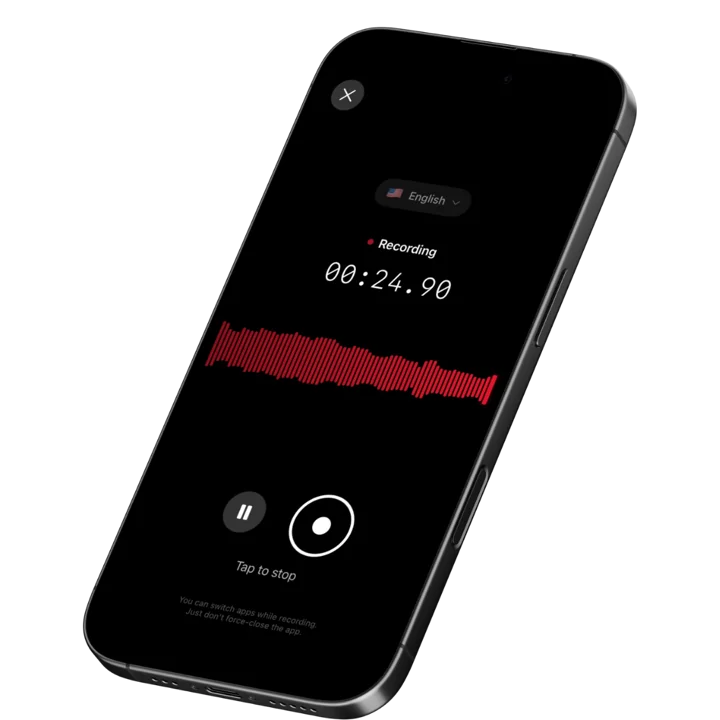
A handoff goes better when the next person gets more than a rushed, half-remembered summary. Speakwise is an iPhone app that records a conversation with one tap and turns it into a transcript, an AI summary, and action items, so the information from a shift change, a patient transfer, or a project handover does not depend on one tired memory. Always get consent from everyone in the conversation before you record, including a patient if they are present for a bedside handoff.
Speakwise's Clinical session note template organizes a recording into subjective, objective, assessment, and plan sections, a format clinicians already use. The transcript shows who said what, so the incoming team can see which person said which details. Speaker identification is not included in every plan. When you start your free trial, pick the plan that includes it. Speakwise reaches 95%+ accuracy in optimal audio conditions and 92%+ in noisy rooms with several speakers, and it works offline, so a handoff on a hospital floor or a factory line does not need a signal.
The same approach works for a project handover or a client transfer outside healthcare: record the conversation, and the next person inherits a transcript and a summary instead of a half-remembered email or a gap in institutional knowledge.
Start with a 7-day free trial ($0.00). After that, Speakwise costs from $69.99 per year, which is about $5.83 a month, billed yearly. Prices shown are for the US and can differ by country.Download Speakwise from the App Store and give your next handoff a written record instead of a rushed conversation.
Try Speakwise free for 7 days
Available on the App Store | iOS Optimized
🎯 4.9★ App Store Rating | 📱 Built for iOS
