Language Barriers at Work Statistics 2027: Costs and Data
TL;DR
Language barriers at work statistics show a real problem. In 2011, 65% of 106 US executives reported a language barrier at work (Forbes Insights). Speakwise transcribes meetings in 100+ languages, so teams can read back what was said, free to try for 7 days.
Used by recruiters, executives, consultants, and more.
Language Barriers at Work Statistics 2027: Costs and Data
Language barriers at work statistics show how often instructions or a safety warning get lost when teams span offices, construction sites, and factory floors with many native languages represented. The same problem shows up in our remote work communication statistics post, where distributed teams already struggle to stay in sync. This guide collects 15 sourced numbers on how common language barriers are and what they can cost.
Key Language Barriers at Work Statistics (2027)
- Language barriers at work were common at large US companies in 2011: 65% of 106 executives surveyed said barriers existed between managers and other workers (Forbes Insights).
- In 2016, 8.6% of people in the United States had limited English proficiency, and 40.5 million spoke Spanish at home (LanguageLine Solutions).
- In 2012, 1.75 billion people worldwide spoke English at a useful level (Harvard Business Review).
- In the EU in 2022, 78.5% of employed adults aged 25 to 64 said they knew at least one foreign language, and 12.3% of all adults that age said they knew three or more (Eurostat).
- 21% of the executives asked about the effects of language barriers named worker safety as one of the most serious, in the same 2011 survey (Forbes Insights).
- The fatal injury rate for Hispanic or Latino workers was 4.3 per 100,000 full-time workers in 2024, and 68.5% of their work deaths were among foreign-born workers (BLS).
- In Japan, 45.8% of employees who work with foreign colleagues reported communication difficulties in a 2024 staffing company survey, and 57.3% of those who did blamed language issues (HCAMag).
1. More than 1 in 5 people age 5 and older in the US spoke a language other than English at home in 2017 to 2021
More than 1 in 5 people in the United States age 5 and older, 22%, spoke a language other than English at home during 2017 to 2021, according to a 2025 press release from the US Census Bureau on its American Community Survey. An earlier Census Bureau estimate, for 2016, found that 8.6% of the US population had limited English proficiency, meaning they told the Census they spoke English less than "very well."
These are not small or shrinking numbers. A population this size means many teams already include coworkers, customers, or vendors who think and speak most comfortably in a language other than English. A meeting, a safety briefing, or a performance review that assumes everyone follows English at native speed will miss a meaningful share of the room.
Sources: U.S. Census Bureau: New Data on Detailed Languages Spoken at Home and Ability to Speak English; LanguageLine Solutions: Over 20 Percent of U.S. Residents Speak a Language Other Than English
2. In 2016, Spanish was spoken at home by 40.5 million people in the US
Spanish was spoken at home by 40.5 million people in the United States, or 13.3% of the population age 5 and older, based on the same 2016 Census Bureau data. Spanish was by far the most common non-English home language that year, followed by Chinese, with about 3.4 million speakers, and Tagalog, with about 1.7 million.
For many workplaces, this single fact explains a lot of day-to-day friction. A company that hires widely from the local labor market, in construction, hospitality, healthcare, or retail, is likely to have a meaningful share of Spanish-speaking employees even without recruiting internationally. Safety instructions, schedules, and HR policies written only in English can leave out workers who understand their job but not every word of the paperwork that describes it.
Source: LanguageLine Solutions: Over 20 Percent of U.S. Residents Speak a Language Other Than English
3. In 2022, 78.5% of employed adults in the EU said they knew at least one foreign language
In 2022, 78.5% of employed people aged 25 to 64 in the European Union said they knew at least one foreign language, according to Eurostat's Adult Education Survey. Europe's patchwork of neighboring countries and languages means that knowing a second language is closer to the norm than the exception for working adults there.
That strength has a limit. Knowing one extra language does not guarantee comfort in every work situation, especially technical meetings, legal contracts, or fast, informal conversation. For a multinational team, "we all speak some English" often means a wide range of comfort levels in the same meeting, from fluent to barely functional. A statistic that stops at "knows a foreign language" can hide how much that language skill actually covers.
Source: Eurostat: Foreign Language Skills Statistics
4. In 2022, only 12.3% of EU adults aged 25 to 64 said they knew three or more foreign languages
Just 12.3% of adults aged 25 to 64 in the European Union said they knew three or more foreign languages in 2022, Eurostat's Adult Education Survey found. Another 24.7% said they knew exactly two, and 37.6% said they knew exactly one. So about half of the adults who know a foreign language know only one.
This matters for any company that treats "the EU team" as one interchangeable group. A project spanning Germany, Poland, Spain, and Portugal may need more shared languages than most individual employees actually have. Cross-border teams often default to English for this reason, not because English is loved, but because it is the one language more people in the room are likely to share, even imperfectly.
Source: Eurostat: Foreign Language Skills Statistics
5. In 2011, 65% of 106 US executives said language barriers existed between managers and workers at their company
65% of senior executives at large US companies said their company faced language barriers between managers or executives and other workers, according to a 2011 Forbes Insights survey of 106 executives, done in partnership with Rosetta Stone. The companies surveyed all had annual revenues above $500 million, so these are large employers managing diverse workforces at scale, not small local shops.
The survey is old enough that it predates most of today's remote and hybrid work tools, but the underlying dynamic, workers and managers who do not fully share a language, has not gone away. A barrier that two-thirds of the executives surveyed already saw then is not a niche problem.
Source: Forbes Insights: Reducing the Impact of Language Barriers
6. Multilingual workers lose 6.1 hours a week to poor workplace communication
Multilingual knowledge workers, people who are fluent in two or more languages, whose first language is not English, but who use English at work, lose an average of 6.1 hours a week to poor communication, and another 11.9 hours a week to what the survey calls performative productivity, time spent looking busy instead of getting work done. The numbers come from a 2024 survey of 1,032 knowledge workers and 254 business leaders, run by The Harris Poll for Grammarly, which studied multilingual workers as one subgroup of everyone it surveyed.
Those two numbers eat into a large part of a standard work week, time spent fighting the job instead of doing it. The same survey found that 84% of multilingual workers find it hard to keep up with the sheer volume of workplace communication, which is 30 percentage points higher than the average worker. A heavier load of translating, checking tone, and rereading does not show up on an org chart, but it shows up in the hours left over for the actual work.
Source: Grammarly and The Harris Poll: The Productivity Shift, Why Multilingual Workers Need AI
7. In 2011, 21% of executives named worker safety as a major effect of language barriers
21% of the executives asked about the effects of language barriers named worker safety as one of the most significant, according to the same 2011 Forbes Insights and Rosetta Stone survey of 106 US executives. That places safety near the bottom of the eight effects listed, ahead of only employee retention (16%), but it is the effect with the most serious possible outcome.
A missed instruction in an email is an annoyance. A missed instruction on a factory floor, construction site, or hospital unit can injure someone. Companies that run physical, hands-on work, not just office meetings, carry this risk whenever a safety briefing, a warning sign, or a supervisor's instruction is given in a language some workers do not fully understand. The next two statistics come from US injury data. They do not show which deaths involved a language barrier.
Source: Forbes Insights: Reducing the Impact of Language Barriers
8. The fatal injury rate for Hispanic or Latino workers was 4.3 per 100,000 in 2024
The fatal injury rate for Hispanic or Latino workers in the United States was 4.3 per 100,000 full-time-equivalent workers in 2024, down slightly from 4.4 in 2023, according to the Bureau of Labor Statistics' Census of Fatal Occupational Injuries. For comparison, the fatal injury rate for all workers was 3.3 per 100,000 in 2024.
The Bureau of Labor Statistics does not say in this release how many of these deaths involved a language barrier directly. For more on capturing spoken instructions accurately, see our guide to the best app for recording safety training.
Source: U.S. Bureau of Labor Statistics: Census of Fatal Occupational Injuries Summary, 2024
9. 68.5% of Hispanic or Latino worker deaths in 2024 were among foreign-born workers
Of the 1,229 workplace deaths among Hispanic or Latino workers in the United States in 2024, 68.5%, or 842 deaths, were among foreign-born Hispanic or Latino workers, the Bureau of Labor Statistics reported. The release does not say what share of Hispanic or Latino workers are foreign-born, so it does not show whether foreign-born workers are over or under represented in these deaths.
Being foreign-born does not automatically mean someone has limited English proficiency. A safety program that is written and delivered only in English, with no check that every worker actually understood it, is relying on hope rather than evidence that the message got through. Clear, repeatable instructions in a worker's strongest language are a cheap safeguard against an expensive, irreversible outcome.
Source: U.S. Bureau of Labor Statistics: Census of Fatal Occupational Injuries Summary, 2024
10. In a 2024 staffing company poll, 45.8% of employees in Japan who work with foreign staff reported communication problems
45.8% of Japanese employees who work with, or have worked with, foreign colleagues said they have experienced communication difficulties, according to Staff Service Holdings' own 2024 survey of 1,467 employees, reported by HCAMag. Among those who had trouble, 57.3% blamed language issues directly, and 32.3% pointed to misunderstandings or mistakes from insufficient Japanese comprehension.
This shows language barriers run in both directions. The Japanese research here describes local staff struggling to communicate with foreign coworkers, the reverse of the US data earlier in this post, where English speakers are often the default and others must adapt. Wherever the "default" language sits, whoever did not grow up speaking it carries extra translation work in their head during every conversation.
Source: HCAMag: What's the Biggest Barrier for Japanese Workers Interacting With Foreign Staff?
11. In the same poll, 53.4% of managers, executives and senior employees said their organization has no program to teach foreign staff Japanese
53.4% of Japanese managers, executives, and senior employees said their organization has no program to help foreign staff learn Japanese, according to the same Staff Service Holdings' own 2024 survey of 1,467 employees. That is a majority of the managers and senior employees polled.
This gap is easy to miss from the top of an organization. Leaders who already share a working language with their peers may not notice how much extra effort language costs employees lower down, or on a different team, until turnover or mistakes make the cost visible. A formal language program is not the only fix, but 53.4% with no program at all suggests many of these organizations have no formal language support.
Source: HCAMag: What's the Biggest Barrier for Japanese Workers Interacting With Foreign Staff?
12. In 2012, 1.75 billion people worldwide spoke English at a useful level
1.75 billion people around the world spoke English at a useful level, Harvard Business School professor Tsedal Neeley wrote in a 2012 Harvard Business Review article on English as the language of global business. Companies including Airbus, Nokia, Samsung, SAP, and Renault have all made English their official corporate language at some point, even in countries where almost no one speaks it as a first language.
That scale is exactly why English feels universal in business. 1.75 billion is a large number, but by Neeley's own account it was still a minority of the world's population at the time. Treating English as a neutral, shared default can ignore how much work it takes for some people in the room to reach "useful," let alone fluent.
Source: Harvard Business Review: Global Business Speaks English
13. The EF English Proficiency Index tested 2.2 million adults across 123 countries
The 2025 EF English Proficiency Index is based on test results from 2.2 million adults across 123 countries and regions, making it one of the largest rankings of English skill by country. The Netherlands ranked first, with a score of 624 rated "Very High," ahead of Croatia, Austria, Germany, and Norway.
The Index is EF's own ranking, built from adults who chose to take EF's online test, so it is not a random sample of each country. A country-level score also hides individual variation. Within any single country, some employees will test far above their national average and some far below it, so a company cannot assume uniform English ability just because it operates in a high-scoring country.
Source: EF: English Proficiency Index 2025
14. 90% of multilingual workers have considered finding a new job over communication problems
90% of multilingual knowledge workers say they have thought about finding a new job because of communication struggles at work, which is 27 percentage points above the average worker. The same 2024 survey of 1,032 knowledge workers and 254 business leaders, run by The Harris Poll for Grammarly, found that 92% of multilingual workers report increased stress at work, 10 percentage points above the average worker.
This pairing is worth sitting with. A language gap does not stay contained to one bad meeting. For the person living with it every day, it becomes a reason to start looking for a new job. Losing a skilled multilingual employee over communication friction costs a company training time, hiring costs, and institutional knowledge, a career cost that is easy to miss until someone already has one foot out the door.
Source: Grammarly and The Harris Poll: The Productivity Shift, Why Multilingual Workers Need AI
15. 84% of executives agree workers are more productive when managers speak their language
84% of executives agreed that workers are more productive when managers or executives communicate with them in their native language, according to the same 2011 Forbes Insights and Rosetta Stone survey of 106 US executives. In that survey, 93% agreed that expatriate managers are more successful when they are bilingual, and 82% said multicultural, multilingual managers with international experience are more valuable than other employees.
Here the data shows what executives believe helps, not just what goes wrong. Executives overwhelmingly recognize the benefit of meeting people in their own language, even if company policy still defaults to English for convenience. Teams that act on this, by hiring multilingual managers, translating key documents, or simply slowing down to check understanding, are working with the data instead of against it. For teams that already lean on recording and transcription, our picks for the best AI app for non-English meeting transcription cover tools built for exactly this gap.
Source: Forbes Insights: Reducing the Impact of Language Barriers
What These Language Barrier Numbers Add Up To
Put together, these numbers describe a problem that is both real and uneven. Many large organizations report a language barrier somewhere: 65% of the 106 US executives surveyed in 2011 saw one between managers and workers, and 45.8% of the employees in a 2024 Japanese staffing company poll reported communication trouble with foreign colleagues. But the people who carry the cost are rarely the ones setting the language policy.
The costs also scale with the stakes of the conversation. In an office, a language barrier mostly shows up as lost hours and slower teamwork. One survey found multilingual workers lose 6.1 hours a week to poor communication, though it does not say how much of that comes from language. On a construction site or a factory floor, the stakes turn physical. The fatal injury data in this post does not say language caused any specific death. It does show Hispanic and Latino workers dying on the job at 4.3 per 100,000 full-time workers in 2024, against 3.3 for all workers. The risk rises with how physical and immediate the work is.
None of this points to English, or any single language, as the villain. English works precisely because so many people have learned it well enough to use. The real gap sits between the language a meeting is held in and how well every person in the room actually follows it, a gap that rarely gets checked in the moment and often shows up later, as a mistake or an injury.
Language barriers at work are common, costly, and usually invisible until something goes wrong.
Read Back What Was Said, in 100+ Languages
Most of the statistics above share one root problem: something was said, and it did not fully land. That gap is hard to close in the room, in the moment, especially for anyone still working in a second language. It gets much easier to close after the fact, if there is an accurate record of what was actually said.
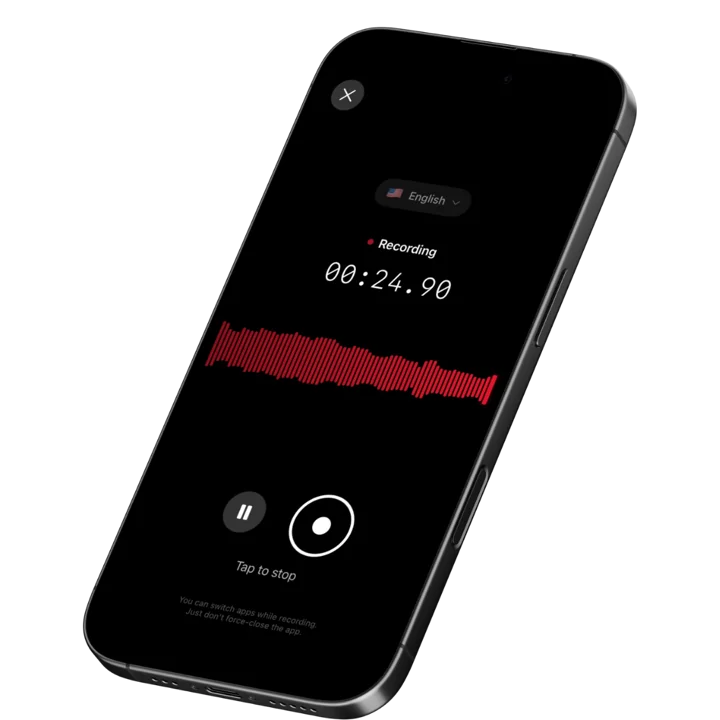
Speakwise records in-person meetings, safety briefings, and conversations with one tap, then transcribes them in whichever of its 100+ supported languages it detects automatically. A meeting held in Spanish gets a Spanish transcript, and a meeting held in English gets an English transcript, so nobody has to rely only on a note-taker's memory of a fast-moving conversation. Speakwise reaches 95%+ accuracy in optimal audio conditions and 92%+ in noisy rooms with several speakers, and Custom Words lets you add names, brands, and jargon so the app listens for the terms your workplace actually uses. Speaker identification shows who said what when several people are talking. Speaker identification is not included in every plan. When you start your free trial, pick the plan that includes it.
Start with a 7-day free trial ($0.00). After that, Speakwise costs from $69.99 per year, which is about $5.83 a month, billed yearly. Prices shown are for the US and can differ by country.Download Speakwise from the App Store and read back what was said, in 100+ languages.
Try Speakwise free for 7 days
Available on the App Store | iOS Optimized

🎯 4.9★ App Store Rating | 📱 Built for iOS
