Billable Hours Statistics 2027: How Much Lawyers Bill
TL;DR
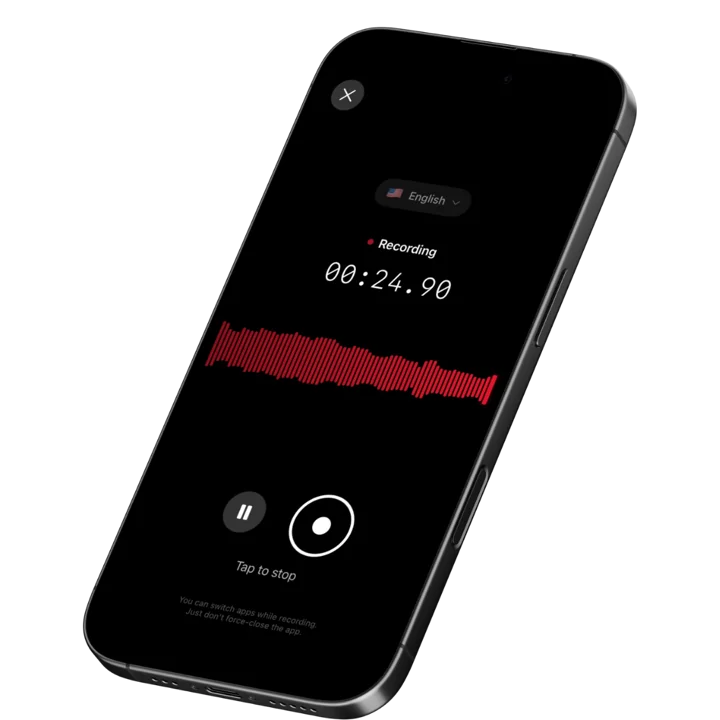
Billable hours statistics for 2027 show lawyers bill for only part of each workday. In Clio's 2025 data, lawyers bill just 2.4 hours of an 8-hour day (Clio). Speakwise records a meeting on iPhone into a Legal file note, with a 7-day free trial.
 Speakwise - AI Note Taker
Never miss a key detail
- Smart summaries and action items.
- Speaker diarization labels who said what.
- Unlimited premium transcription.
- Auto-sync to Notion.
- Record offline, even with no signal.



Used by recruiters, executives, consultants, and more.
Billable Hours Statistics 2027: How Much Lawyers Bill
Billable hours statistics for 2026 show that lawyers collect payment for only a fraction of each workday, even at firms built entirely around the billable hour. This post covers 16 billable hours statistics on firm targets and AI. For more on how lawyers use recording day to day, see our best transcription app for lawyers guide.
Key Billable Hours Statistics (2027)
- Billable hours statistics show that lawyers who use Clio collect payment for only 2.4 hours of billable work in an 8-hour day (Clio: 2025 Legal Trends Report).
- Clio reports that law firms using Clio collected nearly twice as many billable hours each day in 2025 as in 2016 (Clio: 2025 Legal Trends Report).
- Associates worked 2,081 hours in 2014 but billed only 1,806 of them, about 87% (NALP: Update on Associate Hours Worked).
- In 2015, law firms required associates to bill an average of 1,892 hours a year, rising to 1,930 hours at firms with more than 700 lawyers (NALP: Update on Associate Hours Worked).
- 52% of Gen Z associates said they would trade pay for fewer billable hours, in a 2024 survey of 546 junior associates, mostly at large firms, by Major, Lindsey & Africa (Major, Lindsey & Africa: Beyond Tradition: Gen-Z's Approach to Big Law).
- Lawyer worked rates jumped 7.3% in 2025, the fastest growth on record, even though 90% of legal fees still run through hourly billing (Thomson Reuters Institute: 2026 Report on the State of the US Legal Market).
- Professionals in Thomson Reuters' own 2024 survey predicted AI could save them 12 hours a week by 2029 and about 4 hours a week in the next year, worth an estimated $100,000 a year in added billable time for a typical US lawyer (Thomson Reuters: Future of Professionals Report).
1. Lawyers who use Clio bill only 38% of an 8-hour workday
38% is the average utilization rate for law firms that use Clio, according to its 2025 Legal Trends Report. Clio is a legal practice management software company, and this figure comes from its own anonymized data on paying customers, not an independent survey of the whole legal industry. Clio measures utilization as the share of an eight-hour day that goes toward billable work. A 38% utilization rate means that out of every 8-hour day, a lawyer bills only around 3 hours.
The other five hours go unbilled. Clio does not say how that time is spent. Utilization is the first and biggest leak in the billable hour. Even before a bill goes out the door or a client pays it, more than half of a typical workday is already unbilled. That gap sets the ceiling for everything else: no firm can invoice or collect hours it never billed in the first place.
Source: Clio: 2025 Legal Trends Report
2. An 88% realization rate cuts billed work to 2.6 hours a day
After utilization, the next leak is realization. Clio's 2025 Legal Trends Report found a realization rate of 88%, meaning 88% of the hours a lawyer bills end up on a client invoice. Starting from the roughly 3 hours a lawyer bills in an 8-hour day, an 88% realization rate brings that down to about 2.6 hours of work that ever makes it onto a bill.
The missing hours are billable work that never reaches a client invoice. Realization rate directly measures how much billed work a firm is willing, or able, to actually charge for. A law firm can log plenty of hours and still lose a meaningful share of that value before a single invoice is sent.
Source: Clio: 2025 Legal Trends Report
3. Lawyers who use Clio collect only 2.4 hours of billable work a day
The final leak in the billable hour is collection. Clio's 2025 Legal Trends Report put the average collection rate at 93%, the share of invoiced work that clients actually pay. Combined with utilization and realization, Clio calculates that lawyers who use its software collect payment for only 2.4 hours of billable work out of every 8-hour day.
That means roughly 70% of an assumed 8-hour day does not turn into collected billable hours, once unbilled time, write-offs and unpaid invoices are counted together. The gap between hours worked and dollars collected is the clearest way to see why law firm leaders track utilization, realization and collection as a connected set of numbers, rather than looking at billable hours on their own. Each rate hides a different kind of loss, and only collection shows what a firm actually has in the bank once the month closes.
Source: Clio: 2025 Legal Trends Report
4. Law firms that use Clio collected nearly twice as many billable hours in 2025 as in 2016, Clio reports
Despite the leaks in the billable hour, the trend is improving among law firms that use Clio. Clio's 2025 Legal Trends Report found that, compared with 2016, these firms are invoicing 36% more hours per day, billing 16% more of their billable work to clients, and collecting 7% more of what they bill. Put together, Clio reports that the average firm in its data collected on nearly twice as many billable hours each day in 2025 as it did in 2016. The three gains listed above multiply to about 1.7 times.
Clio's report does not say why these rates improved, and its data covers only firms that use Clio. The improvement shows the billable hour can get more efficient without firms changing how they charge for work, simply by closing the gap between an assumed workday and hours actually paid for.
Source: Clio: 2025 Legal Trends Report
5. In 2015, law firms required associates to bill an average of 1,892 hours a year
1,892 hours a year is the average billable hour requirement across law firms, according to a National Association for Law Placement (NALP) Bulletin based on the 2015-2016 NALP Directory of Legal Employers. NALP collects this figure directly from law firms that list their billable hour requirements in its directory, covering firms of every size across the United States.
That target sits on top of all the unbillable work the utilization statistics above already describe, since a billable hour requirement only counts hours that make it onto a client's bill. The requirement is a target set by the firm, not a guarantee of how many hours an individual lawyer actually bills or gets paid for, which is why it sits alongside, rather than instead of, the utilization, realization and collection numbers.
Source: NALP: Update on Associate Hours Worked
6. In 2015, the average target at firms with more than 700 lawyers was 1,930 hours, and more than a quarter of their offices required 2,000
The same NALP Bulletin found that the average billable hour requirement rises with firm size, reaching 1,930 hours a year at firms with more than 700 attorneys in 2015. A 2,000-hour requirement is not typical overall, but more than a quarter of offices in firms of 700 or more lawyers reported one in 2015, up from about 19% in the prior year, though below the 35% reported in 2008.
A 2,000-hour annual requirement is demanding by design, since it counts only time that makes it onto a client's bill, with no allowance for vacation, sick days, training or the unbillable work that fills the rest of a lawyer's actual schedule. NALP has tracked requirements like this for years, and its data shows the largest firms consistently setting the highest bar.
Source: NALP: Update on Associate Hours Worked
7. Associates worked 2,081 hours in 2014 but only billed 1,806 of them
The gap between hours worked and hours billed shows up directly in NALP's own data. Associates at reporting firms worked an average of 2,081 hours in 2014, up from 2,067 in 2013, and billed an average of 1,806 hours in 2014, up from 1,786 in 2013. The two averages come from different sets of offices.
That gap of about 275 hours in 2014 is roughly 13% of the hours worked. NALP does not say how the unbilled time was spent. It is a much smaller unbilled share than Clio's utilization figure, because NALP compares billed hours with hours reported as worked, while Clio compares them with an assumed 8-hour day.
Source: NALP: Update on Associate Hours Worked
8. The 1,800-hour requirement faded: 18% of offices reported it in 2015, down from about 30% in 1998
In 1998, 1,800 billable hours a year was the single most common requirement among law firms, reported by about 30% of offices, according to NALP. By the time of NALP's 2016 update, only 18% of offices still reported an 1,800-hour requirement, while a 2,000-hour requirement had ranged from 9% to 17% of reported requirements since 2004.
NALP describes this as the whole distribution moving "to the right" since 1998. NALP cannot track changes at individual firms, so its data do not show whether firms raised their targets. The overall average requirement barely moved between 2008 (1,888 hours) and 2015 (1,892 hours). For a profession that already has a reputation for long hours and high stress, a billable hour target that has moved up since the 1990s helps explain why associate wellbeing keeps coming up alongside the billable hour itself.
Source: NALP: Update on Associate Hours Worked
9. 52% of Gen Z associates would trade pay for fewer billable hours
In a 2024 survey of 546 junior and early-career associates, most at large US law firms, legal recruiting firm Major, Lindsey & Africa and Leopard Solutions found that 52% of Gen Z associates would trade part of their salary to cut their billable hours quota, if they had the choice. The same survey found that, across all respondents, 36% would trade pay for more time off and 27% would trade it for a flexible schedule.
The survey was fielded in January and February 2024 and is Major, Lindsey & Africa's own research, released jointly with Leopard Solutions, so it reflects the 546 associates who took part, most of them at AmLaw 200 firms, not the whole profession. The desire to cut hours was not even across the group either: women wanted billable hour quotas reduced 16 percentage points more often than men did, a sign that the billable hour's toll falls unevenly across a firm.
Source: Major, Lindsey & Africa: Beyond Tradition: Gen-Z's Approach to Big Law
10. Worked rates jumped 7.3% in 2025, the fastest growth on record
Worked rates, the hourly rates lawyers charge for the time they log, grew 7.3% in 2025, the fastest pace on record, according to the 2026 Report on the State of the US Legal Market from the Thomson Reuters Institute and the Center on Ethics and the Legal Profession at Georgetown Law. The same report found the average law firm grew profit by 13% and saw its best year of demand growth since the Global Financial Crisis.
Rate growth that outruns everything else is a warning sign as much as a win. The report frames record profits as sitting on "increasingly unstable ground," since rates this high depend on clients continuing to accept them even as cheaper alternatives, including AI tools, become more capable every year.
Source: Thomson Reuters Institute: 2026 Report on the State of the US Legal Market
11. 90% of legal fees still run through the billable hour
Despite heavy law firm investment in AI, 90% of legal dollars still flow through hourly billing arrangements, according to the same 2026 Thomson Reuters Institute and Georgetown Law report. The report calls this a structural business model conflict: firms are buying AI tools that finish work faster, while still charging for that work mostly by the hour.
That tension is what makes the billable hour harder to defend over time. If a task that used to take three hours now takes 45 minutes with AI, hourly billing means either the client's bill shrinks by the same amount or the firm has to explain why it did not. Firms that keep billing by the hour without changing their rates or scope are betting that clients will not notice, or will not mind, for now.
Source: Thomson Reuters Institute: 2026 Report on the State of the US Legal Market
12. Only 41% of firms in Clio's data billed exclusively by the hour in 2024
In 2024, only 41% of law firms billed their clients exclusively by the hour, according to Clio's 2025 Legal Trends Report. More than half of firms, 54%, billed both hourly and flat fees, and in total 59% of firms used flat fees exclusively or alongside an hourly rate.
The shift toward flat fees has been building since 2020, and Clio links part of it to AI: firms that use AI more widely are more likely to see an effect on revenue, and more likely to have already adjusted their pricing. Flat fees give clients cost certainty that hourly billing cannot, which matters more every year as AI tools make the time a task takes less predictable and less tied to its value.
Source: Clio: 2025 Legal Trends Report
13. 1 in 5 heavy AI users say AI is straining their billable targets
Among legal professionals using AI more widely, one in five say AI is posing a challenge to meeting their billable hour targets, according to Clio's 2025 Legal Trends Report. Most other legal professionals report no issue yet, or have no opinion on the impact, but the heaviest AI users are the ones starting to feel the squeeze first.
That squeeze is an early sign of tension between AI and the billable hour model. If a lawyer uses AI to draft a document in minutes instead of hours, and still bills by the hour, there is simply less time left to bill. Firms that adopt AI widely without rethinking how they charge for work are the first to run into this problem, not the last.
Source: Clio: 2025 Legal Trends Report
14. 45% of heavy AI adopters have already changed their pricing
Nearly half, 45%, of law firms using AI more widely have already made adjustments to their pricing because of it, according to Clio's 2025 Legal Trends Report. Of all the heavy AI users surveyed, 26% raised what they charge, 11% reduced pricing, and 8% introduced new types of fees for AI-assisted work, which adds up to the 45%. By contrast, 70% of firms using AI only partially have made no pricing changes at all.
The split shows that heavy AI users were more likely to change their pricing than light users, though a single survey cannot show which came first. For now, more heavy AI users raised their prices than lowered them.
Source: Clio: 2025 Legal Trends Report
15. Professionals in a 2024 survey expect AI to free up 12 hours a week by 2029
Professionals working in legal, tax, and risk and compliance fields around the world predicted that AI could free up 12 hours of their time per week by 2029, according to Thomson Reuters' own 2024 Future of Professionals survey of more than 2,200 professionals. In the next year alone, they predicted AI would save about 4 hours a week, which Thomson Reuters calculates as roughly 200 hours a year.
Thomson Reuters compares that near-term saving to the productivity gain of adding one extra colleague for every 10 people already on a team. For lawyers who bill by the hour, that freed-up time is also a direct business decision: whether to pocket it as extra capacity, pass it on to clients, or use it for more client meetings and case work instead.
Source: Thomson Reuters: Future of Professionals Report
16. The roughly 200 hours AI could save in a year are worth nearly $100,000 to a US lawyer, Thomson Reuters estimates
Thomson Reuters estimates that the roughly 200 hours a year AI could save a US lawyer translate to nearly $100,000 a year in additional billable time, based on its 2024 Future of Professionals report. The company calculated the figure using financial data gathered directly from participating law firms' own financial management systems, then anonymized and aggregated across the industry.
Whether that time actually becomes $100,000 depends entirely on how a firm chooses to use it. Thomson Reuters notes that lawyers could reinvest AI-driven time savings into more billable work, into business development, or into other strategic initiatives. Firms that only use AI to work faster, without changing what they bill for, are the ones most likely to see that value disappear instead of showing up on an invoice.
Source: Thomson Reuters: Future of Professionals Report
The Billable Hour Is Leaking on Both Ends
Two forces are squeezing the billable hour at once. On one end, the utilization, realization and collection numbers show that most of a lawyer's day was never going to be fully billable in the first place, long before AI entered the picture. On the other end, AI could cut into the hours that are billable, finishing in minutes what used to take an afternoon.
The result is a profession that still sets ambitious hour targets, from the 1,892-hour average requirement in 2015 to the 1,930-hour average at the largest firms, while AI may make the work available to fill those hours faster to produce. That mismatch is not new, and it has not gone away. In a 2024 survey, more than half of Gen Z associates said they would still trade part of their pay for fewer billable hours, and wellbeing research connected to overwork, including broader employee burnout statistics, has only grown louder since.
Where this goes next depends on what law firms choose to bill for. Firms moving to flat fees are betting that clients will pay for outcomes, not hours. Worked rates that grew 7.3% on average in a single year suggest clients are still paying for hours. Both bets cannot win forever, and the gap between hours worked, hours billed and hours actually paid for is where that argument will be settled.
The billable hour survives for now, and AI could put more pressure on it as the work gets faster.
Speakwise Turns a Client Meeting Into a Transcript and Summary
Every hour a lawyer spends typing up notes after a client meeting is an hour that is hard to bill and easy to lose to the utilization gap described above. Speakwise is an iPhone app that records in-person client meetings with one tap and turns them into a transcript and an AI summary, so you have a written record of the meeting without typing it up yourself.
Speakwise's Legal file note template turns a recording into a summary built around the parties, the facts, each side's position and the deadlines, so you do not have to build that structure by hand after every meeting. The transcript shows who said what, which matters in a client meeting with more than one party in the room. Speaker identification is not included in every plan. When you start your free trial, pick the plan that includes it. Speakwise users report saving about 73% of their post-meeting follow-up time (Speakwise user surveys), and the app reaches 95%+ accuracy in optimal audio conditions and 92%+ in noisy rooms with several speakers. For paralegals doing similar client-facing work, our guide to recording client intake interviews covers the same idea from a different seat at the table.
Start with a 7-day free trial ($0.00). After that, Speakwise costs from $69.99 per year, which is about $5.83 a month, billed yearly. Prices shown are for the US and can differ by country.Download Speakwise from the App Store and turn a client meeting into a transcript, summary and Legal file note instead of an evening of write-up work.
Try Speakwise free for 7 days
Available on the App Store | iOS Optimized
🎯 4.9★ App Store Rating | 📱 Built for iOS
