Knowledge Hoarding Statistics 2027: Why People Hold Back
TL;DR
Knowledge hoarding statistics track knowledge hiding, holding back an answer. A 2023 review of 131 studies found burnout has the strongest link, at 0.54 (Skerlavaj et al.). Speakwise's iPhone app shares summaries by link or Notion sync, no retelling needed, with a 7-day free trial.


Used by recruiters, executives, consultants, and more.
Knowledge Hoarding Statistics 2027: Why People Hold Back
Knowledge hoarding statistics mostly describe knowledge hiding, refusing to answer when a coworker asks directly. The reasons are rarely laziness: people weigh job security, credit, and trust before deciding what to share, and hybrid teams raise the stakes with fewer hallway chats to fill the gaps a meeting left out. This post covers 17 statistics from peer-reviewed research on why people hold back.
Key Knowledge Hoarding Statistics (2027)
- Knowledge hoarding is a close cousin of knowledge hiding, a construct a 2012 study split into three forms, evasive hiding, rationalized hiding and playing dumb, all predicted by distrust (Connelly et al., 2012).
- A 2023 meta-analysis of 131 studies found burnout has the strongest link to knowledge hiding of all the risk factors it tested, with a correlation of 0.54 based on 4 studies and 1,094 workers (Skerlavaj et al., 2023).
- Distrust also has a strong link to knowledge hiding, at a correlation of 0.43, ahead of job insecurity at 0.36 (Skerlavaj et al., 2023).
- Psychological safety has the strongest negative link to knowledge hiding, at a correlation of negative 0.47 (Skerlavaj et al., 2023).
- Knowledge hiding has almost no link to how much people share knowledge in general, at a correlation of only negative 0.06, confirming they are different habits (Skerlavaj et al., 2023).
- A field study of 240 employees in 34 workgroups found that people who hid more knowledge were less creative themselves (Cerne et al., 2014).
- A single survey of 691 workers linked knowledge hiding to voluntary turnover, but two larger meta-analyses, with 3,808 and 1,616 workers, found no significant link to the intention to quit (Serenko and Bontis, 2016; Skerlavaj et al., 2023; Zhang, Takahashi and Rezwan, 2025).
1. Knowledge hiding has three distinct forms, and distrust predicts all of them
In 2012, management professors Catherine Connelly, David Zweig, Jane Webster and John Trougakos ran three studies and found that holding back knowledge at work is not one behavior but three. They named them evasive hiding (promising information and then not delivering it), rationalized hiding (giving an excuse for not helping) and playing dumb (pretending not to know the answer). The study also compared knowledge hiding to a related idea, knowledge hoarding, where someone keeps knowledge to themselves even without being asked for it. Across their studies, one factor predicted all three forms of hiding: distrust. When an employee does not trust the person asking, they are more likely to hide what they know, whichever of the three tactics they use.
2. A 2023 meta-analysis pooled 47,348 workers to map what drives knowledge hiding
Ten years after knowledge hiding was first defined, researchers Miha Skerlavaj, Matej Cerne and Sasa Batistic combined the results of 131 separate studies, covering 147 samples and 47,348 participants, into one large meta-analysis. It was larger than the other meta-analysis published in 2022, which used 104 studies and 31,822 participants. The team tested which workplace factors raise or lower the odds that someone holds back an answer, and which outcomes follow when they do. Because the analysis drew on 131 studies and 147 samples from North America, Europe, Asia and Oceania, the findings below are not a one-off result from a single survey. Each one rests on only some of those studies. They reflect a pattern researchers have measured again and again across a decade of research.
Source: Economic and Business Review: Knowledge Hiding in Organizations, Meta-Analysis 10 Years Later, Skerlavaj, Cerne and Batistic, 2023 (full text)
3. Burnout has the strongest link to knowledge hiding of any risk factor measured
Across 4 studies and 1,094 workers, the 2023 meta-analysis found burnout has a correlation of 0.54 with knowledge hiding, the strongest single link of any risk factor the researchers tested. A correlation this size means employees who report more burnout also tend to report more knowledge hiding, though it comes from only 4 studies. The researchers see this as a matter of conserving energy: once someone is emotionally exhausted, answering a coworker's question or walking a new hire through a task costs effort they feel they do not have left. Hiding knowledge becomes a way to protect the little energy that remains, even when it hurts the team later. That makes burnout one of the clearest places to start for any organization that wants to bring knowledge hiding down, though a correlation this size cannot prove that fixing burnout would fix the hiding too.
Source: Economic and Business Review: Knowledge Hiding in Organizations, Meta-Analysis 10 Years Later, Skerlavaj, Cerne and Batistic, 2023 (full text)
4. Distrust and job insecurity are also linked to knowledge hiding
The same meta-analysis found distrust has a correlation of 0.43 with knowledge hiding, based on 9 studies and 2,940 workers, and job insecurity has a correlation of 0.36, based on 6 studies and 1,547 workers. The distrust number backs up the original 2012 research: people hide knowledge when they do not trust a colleague. Job insecurity is the fear of losing your job, which the 2023 authors think can push knowledge hiding for a similar reason. When employees are not confident their job is safe, holding on to specialized knowledge can feel like the only leverage they have left. Both factors point to the same pattern: knowledge hiding tends to be lower where people feel secure and trusted, not where they feel expendable.
Source: Economic and Business Review: Knowledge Hiding in Organizations, Meta-Analysis 10 Years Later, Skerlavaj, Cerne and Batistic, 2023 (full text)
5. A competitive climate goes with more knowledge hiding, a collaborative one with less
Workplace climate goes with how much knowledge people hide. The 2023 meta-analysis found a competitive climate, where employees are compared and ranked against each other, has a correlation of 0.29 with knowledge hiding, based on 7 studies and 1,623 workers. A collaborative climate, where effort and improvement matter more than beating a colleague, has a smaller, opposite correlation of negative 0.14, based on 8 studies and 1,674 workers. In other words, workplaces where people feel they are competing for the same promotion, bonus or recognition tend to have more people who hold back an answer that would help a rival. Workplaces built on shared goals and team based credit tend to have somewhat fewer, though that link is weaker than the one for competition.
Source: Economic and Business Review: Knowledge Hiding in Organizations, Meta-Analysis 10 Years Later, Skerlavaj, Cerne and Batistic, 2023 (full text)
6. Abusive bosses have a much stronger link to more knowledge hiding than ethical bosses have to less of it
Leadership style matters too. The meta-analysis found abusive supervision has a correlation of 0.45 with knowledge hiding, based on 9 studies and 2,607 workers, while ethical leadership has a smaller, opposite correlation of negative 0.17, based on 9 studies and 3,067 workers. A third factor, a high quality relationship between a manager and an employee, has a correlation of negative 0.26. The pattern suggests bad leadership does more damage than good leadership repairs. A team with a manager who belittles or punishes employees tends to hide much more than a team with a thoughtful, fair manager tends to open up. The study did not test what happens when an abusive manager is replaced or when a training program is offered.
Source: Economic and Business Review: Knowledge Hiding in Organizations, Meta-Analysis 10 Years Later, Skerlavaj, Cerne and Batistic, 2023 (full text)
7. Psychological safety has the strongest negative link to knowledge hiding
Of every factor tested in the 2023 meta-analysis, psychological safety, the sense that it is safe to speak up or admit a mistake without being punished for it, had the strongest negative correlation with knowledge hiding: negative 0.47, based on 7 studies and 2,385 workers. Interpersonal justice, meaning people are treated fairly and with respect, had a correlation of negative 0.39, based on 3 studies and 763 workers. Psychological safety was about as strong as the strongest factors that go with more hiding. Only burnout, at 0.54, was clearly stronger. Interpersonal justice was a little weaker than distrust, at 0.43. That makes psychological safety the clearest signal in the research for where knowledge hiding runs low: teams where people trust they will not be mocked or blamed for an honest answer hide far less of what they know.
Source: Economic and Business Review: Knowledge Hiding in Organizations, Meta-Analysis 10 Years Later, Skerlavaj, Cerne and Batistic, 2023 (full text)
8. Feeling knowledge is "mine" can lead to hiding it, but through a sense of territory
In 2013, researcher He Peng at Fudan University surveyed 190 knowledge workers in China across three separate survey waves. The study found that employees who felt strong personal ownership over a piece of knowledge were more likely to treat it as private territory, and that this sense of territory, not the ownership feeling itself, was what drove them to hide it from coworkers. The 2023 meta-analysis also found a link: knowledge ownership and territoriality together have a correlation of 0.24 with knowledge hiding, based on 15 studies and 4,079 workers, a real link but a weaker one than burnout's or distrust's. Together, the two studies suggest that knowledge hiding is often less about rules or policy and more about a personal sense that "this is mine."
Source: Journal of Knowledge Management: Why and When Do People Hide Knowledge, Peng, 2013 and Economic and Business Review: Knowledge Hiding in Organizations, Meta-Analysis 10 Years Later, Skerlavaj, Cerne and Batistic, 2023 (full text)
9. Knowledge hiding is not simply the opposite of knowledge sharing
A common assumption is that someone who shares little also hides a lot, as if sharing and hiding sit at opposite ends of one scale. The 2023 meta-analysis tested this directly across 14 studies and 3,376 workers and found almost no relationship between the two: a correlation of only negative 0.06, which the researchers describe as no meaningful association at all. This confirms what the original 2012 research proposed when it first separated the two ideas. A quiet employee who rarely volunteers information is not necessarily hiding anything. Someone else might share freely in general conversation and still refuse a direct request for one specific piece of knowledge. Fixing a sharing problem and fixing a hiding problem call for different solutions, because they are not the same problem.
Source: Economic and Business Review: Knowledge Hiding in Organizations, Meta-Analysis 10 Years Later, Skerlavaj, Cerne and Batistic, 2023 (full text)
10. Hiding knowledge from coworkers is linked to lower creativity for the hider
In 2014, researchers Matej Cerne, Christina Nerstad, Anders Dysvik and Miha Skerlavaj published a field study of 240 employees across 34 workgroups in the Academy of Management Journal. They found that employees who hid more knowledge from coworkers were less creative themselves. The link was weaker in teams that focused on learning and improving. The researchers call this a reciprocal distrust loop: once someone hides knowledge, coworkers learn not to share with that person in return, which cuts the hider off from the ideas and feedback that creativity depends on. A second study, an experiment with 132 undergraduate students, reproduced the same pattern under controlled conditions. The lesson cuts against a common assumption that hiding knowledge protects a competitive edge. Instead, it can quietly wear down the very edge a person was trying to protect.
11. A separate meta-analysis puts a number on the creativity and performance cost
A 2025 meta-analysis in Frontiers in Psychology, combining 66 studies and 20,603 participants, found a moderate link between knowledge hiding and creative and innovative performance: a correlation of negative 0.398, based on 12 studies and 4,413 people. It found a similarly moderate link with task performance, a correlation of negative 0.465, based on 6 studies and 1,859 people. Both numbers confirm that knowledge hiding is not a victimless habit, even though each rests on a subset of the full 66 studies, not all 20,603 people. People who hide knowledge also tend to do less creative work and score lower on task performance, which fits the idea that coworkers stop helping them back. This pattern is not a quirk of one company or one survey. It shows up broadly, wherever researchers have looked for it.
12. Knowledge hiding goes along with rude behavior and rule breaking at work
Knowledge hiding also goes along with how people treat each other at work. The 2023 meta-analysis found knowledge hiding has a correlation of 0.62 with incivility (rude behavior), based on 5 studies and 1,209 workers, and a correlation of 0.39 with workplace deviance (breaking work rules), based on 4 studies and 1,220 workers. A correlation of 0.62 is among the strongest relationships in the entire study, stronger even than the link between burnout and hiding in the first place. The paper does not say who is rude or who breaks the rules, only that these go along with hiding. Either way, knowledge hiding is not linked to smoother relationships at work.
Source: Economic and Business Review: Knowledge Hiding in Organizations, Meta-Analysis 10 Years Later, Skerlavaj, Cerne and Batistic, 2023 (full text)
13. Worse workplace relationships go along with knowledge hiding
The same meta-analysis found a correlation of 0.30 between knowledge hiding and a measure researchers call deterioration of workplace relationships, based on 5 studies and 1,200 workers. This is a broader, longer running outcome than a single rude comment or a one-off argument. It covers a decline in how coworkers get along. Combined with the incivility and deviance numbers above, the picture is consistent: knowledge hiding behaves like a small withdrawal from a trust account that coworkers keep on each other, and the account can run low enough that working relationships themselves start to break down. Teams that want to protect working relationships over the long run have good reason to treat knowledge hiding as a relationship problem, not just an information problem.
Source: Economic and Business Review: Knowledge Hiding in Organizations, Meta-Analysis 10 Years Later, Skerlavaj, Cerne and Batistic, 2023 (full text)
14. A survey of 15 credit unions linked knowledge hiding to voluntary turnover
In 2016, researchers Alexander Serenko and Nick Bontis surveyed 691 knowledge workers across 15 North American credit unions and found that knowledge hiding went along with higher voluntary turnover among the workers surveyed. The same study found that job insecurity motivated knowledge hiding, and that a positive organizational knowledge culture reduced it. The researchers also found that knowledge management systems and written knowledge policies, on their own, had no measurable effect on how much knowledge employees hid. Having a system to store knowledge in did not change whether people were willing to put their knowledge into it in the first place. That willingness went along with the knowledge culture and job insecurity factors above, not with the software available to capture what people knew.
15. Larger studies have not confirmed a link between hiding and wanting to quit
The turnover finding above comes from a single study of 691 workers. When researchers pooled many more studies together, the pattern did not hold up as clearly. The 2023 meta-analysis of 47,348 workers found no statistically significant correlation between knowledge hiding and turnover intention, at 0.20 based on 6 studies and 3,808 workers, and a separate 2025 meta-analysis of 20,603 workers found the same result, at 0.061 based on 5 studies and 1,616 workers. Neither number holds up as a real link once researchers account for how much the results varied across studies. This does not mean quitting and knowledge hiding are never connected at a specific company. It means the connection is not consistent enough across the wider research base to call it a general rule.
Source: Economic and Business Review: Knowledge Hiding in Organizations, Meta-Analysis 10 Years Later, Skerlavaj, Cerne and Batistic, 2023 (full text) and Frontiers in Psychology: Knowledge Hiding and Social Exchange Theory, Zhang, Takahashi and Rezwan, 2025
16. Employees think their coworkers hide more knowledge than they do
The same 2016 survey of 691 knowledge workers found a self-serving pattern: employees consistently rated their own knowledge hiding as lower than they believed their coworkers' hiding to be. Everyone cannot be below average at the same behavior, so the finding points to a blind spot rather than a real difference between groups. People seem to notice and remember the times a colleague held something back far more easily than they notice their own instances of doing the same thing. This blind spot matters for any manager trying to fix a knowledge hiding problem by asking staff to self report it. Employees are likely to describe knowledge hiding as something that happens around them, done by other people, more than something they do themselves.
17. The link to lower performance and satisfaction varies with national culture and wealth
A 2026 meta-analysis in the Journal of Managerial Psychology, by researchers Aoran Hong, Ying Xu and Yonggui Wang, combined 90 separate studies and found knowledge hiding goes with lower job performance and lower job satisfaction. The size of the damage was not identical everywhere. The hit to job performance was stronger in highly competitive, achievement focused cultures, and weaker in cultures with a longer term orientation or higher tolerance for indulgence. The hit to job satisfaction followed a similar pattern: weaker in wealthier countries and those with high power distance, and stronger in highly competitive cultures. The overall conclusion held across the full set of 90 studies: knowledge hiding has a real, measurable cost to how well people perform and how satisfied they are at work, just not the exact same size cost everywhere.
What Drives Knowledge Hoarding, and What Stops It
The research points to one underlying pattern. Many of the factors linked to more knowledge hiding, burnout, distrust, job insecurity, a competitive climate and abusive management, are signs that someone feels unsafe, unsupported or unfairly treated at work. Personality traits such as neuroticism and envy, and a strong sense that knowledge is "mine," had links of similar size, even though they are not about feeling unsafe. Almost every factor linked to less knowledge hiding, psychological safety, interpersonal justice and ethical leadership, is the opposite: a sign the workplace feels safe enough to be honest in. Our look at workplace trust statistics shows how much trust differs between executives and employees, and what high-trust companies gain.
Knowledge hiding has costs beyond a missed answer. It correlates with lower creativity for the hider too, seen in a field study and in a meta-analysis of 12 studies and 4,413 people; see our workplace creativity statistics for more on what helps creative output instead. It also correlates with more incivility and worse relationships at work. The one cost that is smaller than assumed is turnover. A single well cited study found a link to voluntary turnover, but two larger meta-analyses found no significant link to the intention to quit. The clearest related cost shows up after someone finally does leave: our institutional knowledge loss statistics cover what happens once the one person who knew an answer is no longer there to hide or share it.
None of this is primarily a technology problem. Serenko and Bontis found that knowledge management systems and knowledge policies had no impact on how much knowledge employees hid. A positive knowledge culture went with less hiding, and job insecurity went with more. In the 2023 meta-analysis, trust, psychological safety and fair leadership were the factors linked to less hiding. Still, the easiest moment to stop knowledge from disappearing is before anyone has to decide whether to share it at all.
In the research, knowledge hiding goes with burnout, distrust, abusive bosses and low psychological safety. It is also linked to lower creativity for the person who hides.
Make What Was Said Easy to Find, Not Easy to Hide
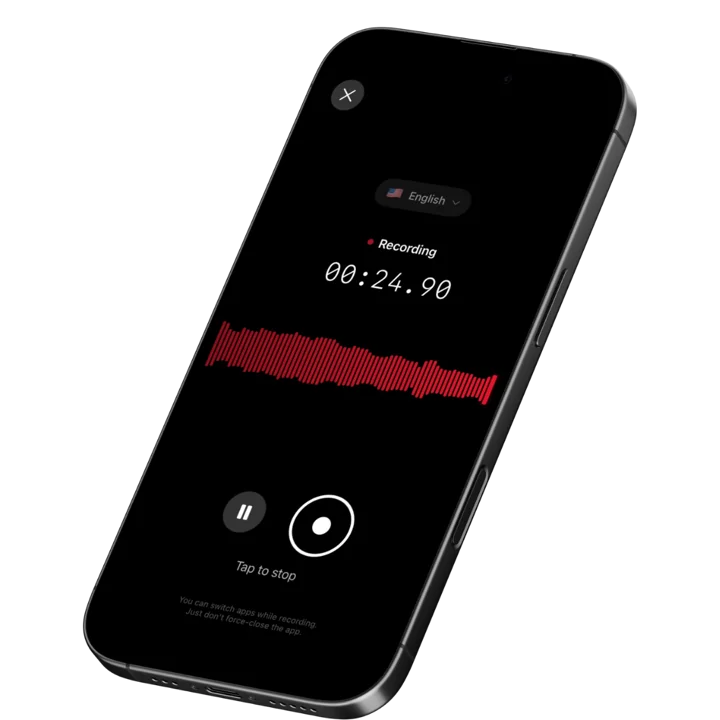
Knowledge hiding usually needs an opportunity: a meeting, a decision or a piece of expertise that only lives in one person's head or notes until they decide whether to pass it on. Speakwise gives you another way to keep what was said. Record a meeting, a one-on-one or a training session with one tap on your iPhone, and Speakwise turns it into a transcript and an AI summary with action items. The summary can go out as a share link, a PDF export, or automatic Notion sync, so what was said is written down and can be shared with the whole team, not just retold by one person.
The transcript also shows who said what. Speaker identification is not included in every plan. When you start your free trial, pick the plan that includes it. Speakwise reaches 95%+ accuracy in optimal audio conditions and 92%+ in noisy rooms with several speakers, and users report saving about 73% of their post-meeting follow-up time (Speakwise user surveys).
Start with a 7-day free trial ($0.00). After that, Speakwise costs from $69.99 per year, which is about $5.83 a month, billed yearly. Prices shown are for the US and can differ by country.Download Speakwise from the App Store and turn every meeting into a transcript and summary you can share by link, PDF or Notion sync, not stuck in one person's notes.
Try Speakwise free for 7 days
Available on the App Store | iOS Optimized

🎯 4.9★ App Store Rating | 📱 Built for iOS
