Meeting Statistics 2026: Time, Cost and Productivity Data
TL;DR
Meeting statistics for 2026 show executives spend nearly 23 hours a week in meetings, a 2017 Harvard Business Review finding. A 2024 Atlassian survey found meetings ineffective 72% of the time. Microsoft found Teams meeting time per user up 252% by early 2022. This post collects 22 meeting statistics, and Speakwise turns each into a transcript, summary and action items.
Used by recruiters, executives, consultants, and more.
Meeting Statistics 2026: Time, Cost and Productivity Data
Meeting statistics show that meetings take up a large part of the work week. A 2017 Harvard Business Review report said executives spend nearly 23 hours a week in them, up from less than 10 hours in the 1960s. Weekly meeting time for the average Microsoft Teams user grew 252% from February 2020 to early 2022. Atlassian's 2024 survey found that meetings are ineffective 72% of the time, and Doodle estimated that pointless meetings would cost more than $541 billion in 2019 in the countries it surveyed. In a small 2021 Microsoft test, stress signals rose after four half-hour meetings in a row.
Most people feel this every week. The calendar fills up, the real work moves to the evening, and nobody remembers what was decided. The numbers below show how big the problem is and where it hurts most.
This page is a hub. It gives the strongest number on each meeting topic: time, volume, cost, wasted meetings, fatigue, video calls, follow-up and AI. Each topic links to a deeper post. Each statistic links to the study, report or news story where it appears.
Key Meeting Statistics (2026)
- Meeting statistics show that executives spend an average of nearly 23 hours a week in meetings, up from less than 10 hours in the 1960s (Harvard Business Review, 2017).
- The average Teams user saw a 252% increase in weekly meeting time since February 2020 (Microsoft Work Trend Index, March 2022).
- Pointless meetings were expected to cost more than $541 billion in 2019 in the countries Doodle surveyed (Doodle, via Workplace Insight).
- Meetings are ineffective 72% of the time, according to a survey of 5,000 knowledge workers (Atlassian, 2024).
- 76% of workers agree they feel drained on days when they have a lot of meetings (Atlassian, 2024).
- 13.8% of women and 5.5% of men felt very or extremely tired after video calls (Stanford News, April 2021).
- 55% of workers say the next steps at the end of a meeting are unclear (Microsoft Work Trend Index, 2023).
How Much Time Do We Spend in Meetings?
1. In 2017, Harvard Business Review reported executives spend nearly 23 hours a week in meetings
A 2017 Harvard Business Review article said executives spend an average of nearly 23 hours a week in meetings. That is up from less than 10 hours in the 1960s. It is more than half of a 40-hour week.
The people who make the biggest decisions have the least time to do the work that follows. Every hour in a meeting is an hour they cannot use to think alone, write or plan.
The number is an average for executives, not for every worker.
See the full breakdown in our time spent in meetings statistics.
Source: Harvard Business Review: Stop the Meeting Madness (2017)
2. The heaviest meeting users spend 7.5 hours a week in Teams meetings
Microsoft's 2023 Work Trend Index looked at the top 25% of users by time spent in Microsoft Teams meetings. These heavy meeting users spend about 7.5 hours a week in Teams meetings. Microsoft counts only meetings held in Teams, so in-person meetings are not in this number. Across the Microsoft 365 apps, the average employee spends 57% of their time communicating (in meetings, email and chat) and 43% creating (in documents, spreadsheets and presentations).
When more than half of the time in these apps goes to talking about work, less than half is left to make things.
Microsoft based the report on a survey of 31,000 people in 31 countries plus trillions of signals from Microsoft 365. It is one of the largest views of how people work.
Source: Microsoft Work Trend Index 2023: Will AI Fix Work?
3. Weekly meeting time for the average Teams user grew 252% from February 2020 to early 2022
Microsoft compared the average Teams user's weekly meeting time with February 2020. By its March 2022 report, weekly meeting time was up 252%. That means the average Teams user spent about three and a half times as long in Teams meetings as in February 2020.
The number covers Microsoft Teams users only, and it counts time in Teams meetings only, so it does not describe every company or every meeting.
Source: Microsoft Work Trend Index 2022: Great Expectations
How Many Meetings Are There?
4. The number of weekly meetings for the average Teams user rose 153%
The same Microsoft report counted meetings, not just minutes. Since February 2020, the number of weekly meetings for the average Teams user rose 153%. So there are more meetings, and each week holds more meeting time.
The number of meetings grew more slowly than total meeting time (153% versus 252%). That tells us meetings did not only multiply. Weekly meeting time grew even faster than the count.
Each meeting also adds a cost that people rarely count: the time to get ready, and the time to get back into focus after.
See more on this in our meeting overload statistics.
Source: Microsoft Work Trend Index 2022: Great Expectations
5. Among the heaviest meeting users, 57% of meetings are ad hoc calls with no calendar invite
Microsoft's 2025 Work Trend Index found that for the 20% of users with the most meetings, 57% of meetings are ad hoc calls without a calendar invite. It also found that 1 in 10 scheduled meetings are booked at the last minute.
Half of all meetings (50%) happen between 9 and 11 am and between 1 and 3 pm. Those are the hours when many people do their best thinking.
For the heaviest meeting users, so many meetings are unplanned that a quiet block on the calendar is hard to protect. A call can land at any moment. These meeting numbers come from Microsoft 365 data up to February 2025, not from the survey.
Source: Microsoft Work Trend Index 2025: Breaking Down the Infinite Workday
What Do Meetings Cost?
6. Pointless meetings were expected to cost more than $541 billion in 2019 in the countries Doodle surveyed
Doodle's State of Meetings report said pointless meetings would waste more than $541 billion of resources in 2019 in the countries it surveyed.
The report was based on interviews with more than 6,500 professionals in the UK, Germany and the USA. Doodle also looked at 19 million meetings booked on its platform in 2018.
This is a 2019 estimate. The point stays the same: a meeting has a price tag, and pointless ones are paid for with wages and lost hours.
See all the numbers in our meeting cost statistics.
Source: Workplace Insight: Pointless meetings set to cost organisations $541bn this year, reporting Doodle's State of Meetings 2019
7. A 2011 paper found most organizations spend 7% to 15% of their personnel budgets on meetings
Most organizations devote 7% to 15% of their personnel budgets to meetings, according to Steven Rogelberg and colleagues. They shared this in their 2011 paper "Wasted Time and Money in Meetings: Increasing Return on Investment."
Personnel budget is what a company pays its people. So up to 15 cents of every payroll dollar goes to time in meetings.
That is a large share. The same authors found that organizations often do little to check what they get back from their meetings. A company would question any other cost this size. The paper also reports that a 1991 sample of managers found more than one-third considered their meeting time unproductive.
Source: SHRM: Fewer Meetings Can Boost Employee and Organization Productivity
How Many Meetings Are Unproductive?
8. Meetings are ineffective 72% of the time
In 2024, Atlassian surveyed 5,000 knowledge workers across four continents. It found that meetings are ineffective 72% of the time.
That is close to three meetings in four. It is what workers reported about how well meetings get work done. The meeting happened, but the work did not move.
If you run meetings, this is the number to test. After your next meeting, ask if anyone left knowing something new, or with a task to do. If not, an email may have done the job.
See more in our unnecessary meetings statistics.
Source: Atlassian: Workplace Woes: Meetings (2024)
9. 77% are often in meetings that end with plans for another meeting
In the same Atlassian survey, 77% of workers said they are often in meetings that end with a decision to schedule a follow-up meeting. One meeting ends with a loose plan, and then a second meeting is needed to sort it out.
This loop is a big reason calendars grow. A meeting that ends without clear decisions and owners does not finish anything. It sets up the next one.
Clear notes can help break the loop. When everyone can see what was decided and who does what, there may be less need for a follow-up call. See more in our meeting productivity statistics.
Source: Atlassian: Workplace Woes: Meetings (2024)
10. 24 billion hours were expected to be lost to pointless meetings in a year in the countries Doodle surveyed
Doodle's 2019 report said 24 billion hours would be lost to pointless meetings in the next year. Doodle said professionals in the UK, Germany and the USA spend about three hours a week in meetings, and two of those hours are in pointless meetings. That is why people feel two thirds of their meetings are unnecessary.
The estimate comes from a survey of more than 6,500 professionals, so it reflects what people believe. It shows how much time workers feel they lose.
Source: Doodle: The State of Meetings 2019
11. Shopify said it would remove 10,000 events, over 76,500 hours of meetings
In January 2023, Shopify cleared a large part of its employees' calendars. A company spokesperson told Fortune the change would eliminate 10,000 company events, or the equivalent of more than 76,500 hours of meetings.
That is a lot of time Shopify said it would give back on purpose. It is one company, so it is not proof for every team. But it shows that a large firm can cut meetings in bulk instead of one at a time.
Source: Fortune: Shopify cutting meetings (January 2023)
Meeting Fatigue and Back-to-Back Meetings
12. 78% struggle to get their work done because of meetings
Nearly 4 in 5 (78%) of Atlassian's respondents said they struggle to get their work done because of how many meetings they must attend each week. Over half said they have to work overtime a few days a week because of meeting overload.
Meetings do not just take their own minutes. They squeeze out the quiet time needed for the tasks that meetings talk about, so work moves into evenings.
The work still has to be done. It just moves to a worse time of day.
Source: Fortune: Atlassian meetings report (2024)
13. 76% say they feel drained on days when they have a lot of meetings
Over three quarters (76%) of workers told Atlassian that they feel drained on days when they have a lot of meetings. That is the tired feeling after a long day of calls, when you still have to finish your own work.
Being tired is not only about hours. Following talk, watching faces and staying ready to speak all use energy.
If a day is packed with meetings, plan for it. Leave the hard thinking for another day, and keep the meeting day for calls.
See more in our meeting fatigue statistics.
Source: Atlassian: Workplace Woes: Meetings (2024)
14. In a 2021 Microsoft test with 14 people, stress rose over two hours of back-to-back meetings
Microsoft's Human Factors Lab asked 14 people to wear EEG caps during video meetings. Each person did two sessions on two Mondays. On one day they sat through four half-hour meetings in a row, two hours in all. Over that time, the average activity of beta waves, which are linked to stress, increased.
On the other day, they had 10-minute breaks between meetings and meditated during each break. With breaks, beta activity dropped. It acted like a reset.
With breaks, brain patterns showed positive frontal alpha asymmetry, which links to higher engagement. Without breaks the levels were negative, which suggests people were withdrawn or less engaged. The test was small, but it backs a simple habit: leave a gap between meetings.
See more in our back-to-back meetings statistics.
Source: Microsoft WorkLab: Brain Research
15. The most-pinged workers are interrupted every two minutes
Microsoft's 2025 Work Trend Index looked at the 20% of Microsoft 365 users who get the most pings, meaning meeting invites, emails and chats. During an eight-hour workday, they get a ping about every two minutes. Over a full 24-hour day, that adds up to 275 pings.
Deep work needs long, quiet stretches. With a ping every two minutes, that time barely exists.
The same report found that meetings after 8 pm are up 16% year over year in Microsoft 365 data up to February 2025, so the day is also getting longer.
Source: Microsoft Work Trend Index 2025: Breaking Down the Infinite Workday
16. Meetings after 8 pm are up 16% year over year
Microsoft also found that meetings after 8 pm are up 16% year over year in Microsoft 365 data up to February 2025. It said global and flexible teams account for much of the increase.
Late meetings are common when a team spans time zones. One side of the call always pays with its evening.
For workers, this blurs the line between work and home. A meeting at 8:30 pm is not a meeting during the day that ran long. It is a new shift.
Source: Microsoft Work Trend Index 2025: Breaking Down the Infinite Workday
Video Meetings
17. 13.8% of women and 5.5% of men felt very tired after video calls
In a 2021 survey, Stanford researchers asked 10,322 people using their Zoom Exhaustion and Fatigue Scale. About one in seven women (13.8%) said they felt very or extremely fatigued after video calls. For men, it was one in 20 (5.5%).
The researchers linked the gap to "mirror anxiety," the stress of seeing your own face on screen, and to feeling stuck in one spot to stay in the camera's view. Women's meetings also tended to run longer, with fewer breaks.
The study shows that fatigue is real and can be measured. It also shows that people feel video meetings in different ways, so one rule will not fit all teams.
See more in our Zoom fatigue statistics.
Source: Stanford News: Zoom fatigue worse for women (April 2021)
18. Camera on made people more tired, in a test with 103 employees
In a study in the Journal of Applied Psychology, researchers used a sample of 103 employees at one company. They randomly assigned half to have their cameras on during meetings and half to have them off. After two weeks, the groups switched.
Having the camera on led to fatigue, rather than just being in more meetings. The team checked the number of meetings and meeting time, so the effect was not only from calendar load.
The study does not say cameras should never be on. It says that a camera-on rule has a cost. Let people turn cameras off in routine calls.
Source: University of Georgia: Cameras, not meetings, cause Zoom fatigue
Remembering and Following Up
19. 55% say the next steps at the end of a meeting are unclear
In Microsoft's 2023 Work Trend Index, 55% of people said next steps at the end of a meeting are unclear. Inefficient meetings ranked as the top thing that hurt productivity.
If nobody knows who does what, the meeting did not finish. The team must ask again, often in another meeting.
A written record can help. Notes that list the decisions and the owner of each task can turn a talk into a plan.
See more in our meeting follow-up statistics.
Source: Microsoft Work Trend Index 2023: Will AI Fix Work?
20. 56% say it is hard to summarize what happened in a meeting
The same report found that 56% of people said it is hard to summarize what happens in a meeting. It also found that 57% struggle to catch up when they join late.
Memory is a weak tool for this job. A meeting has many voices, side talks and changes of plan. Trying to hold all of it in your head while also taking part is hard.
This is why notes matter. See more in our meeting recall statistics.
Source: Microsoft Work Trend Index 2023: Will AI Fix Work?
AI Note-Takers and Meetings
21. In a Microsoft test, Copilot users caught up on a missed meeting nearly 4 times faster
Microsoft tested 60 employees on a recorded 35-minute meeting that had crosstalk and debate. People with Copilot finished summarizing it in about 11 minutes. The control group took more than 42 minutes.
That is nearly 4 times faster. This is a Microsoft study of its own tool, done in a lab-style test. Even so, it shows how much time a good summary can save compared with re-reading or re-watching.
Copilot users included 11 of 15 key meeting details. The control group included 12. Microsoft published the study on November 15, 2023.
See more in our AI meeting assistant statistics.
Source: Microsoft Work Trend Index: What Can Copilot's Earliest Users Teach Us
22. 75% of knowledge workers used AI at work in 2024
Microsoft and LinkedIn's 2024 Work Trend Index said that three in four knowledge workers (75%) used AI at work that year. The survey covered 31,000 people across 31 countries.
Meetings are one of the easiest places to use AI. The work is repeated: capture what was said, sum it up and list the tasks.
The 75% figure is for AI in general, not only in meetings. It shows that by 2024, AI was already a normal part of the workday for most knowledge workers surveyed.
See more in our meeting transcription statistics.
Source: Microsoft: 2024 Work Trend Index on the state of AI at work
What These Meeting Statistics Show Together
The numbers tell one story from two sides. For the average Teams user, Teams meeting time rose 252% and the number of Teams meetings rose 153% from February 2020 to early 2022. In a separate 2024 survey of 5,000 knowledge workers, Atlassian found meetings ineffective 72% of the time, and that 77% of workers are often in meetings that end with plans for another meeting.
The cost is not only money. Even Doodle's 2019 estimate of more than $541 billion misses the quiet costs. Most workers (76%) say they feel drained on days with a lot of meetings, a small 2021 test found stress signals that rose in back-to-back meetings, and the most-interrupted workers get pinged 275 times a day. The hardest part is what happens after. When 55% leave unsure of the next steps, the meeting ends but the work has not started.
For teams, one fix has two parts. Hold fewer meetings and leave gaps between them. Then make sure the ones you keep end with a clear record of decisions and owners. If so many meetings end by planning the next one, a clear record of decisions and next steps is one way to help break that loop.
For the average Teams user, meetings grew fast, and workers say many fall short. A clear record of decisions and next steps is one way to make each one count.
Capture the Meeting With Speakwise
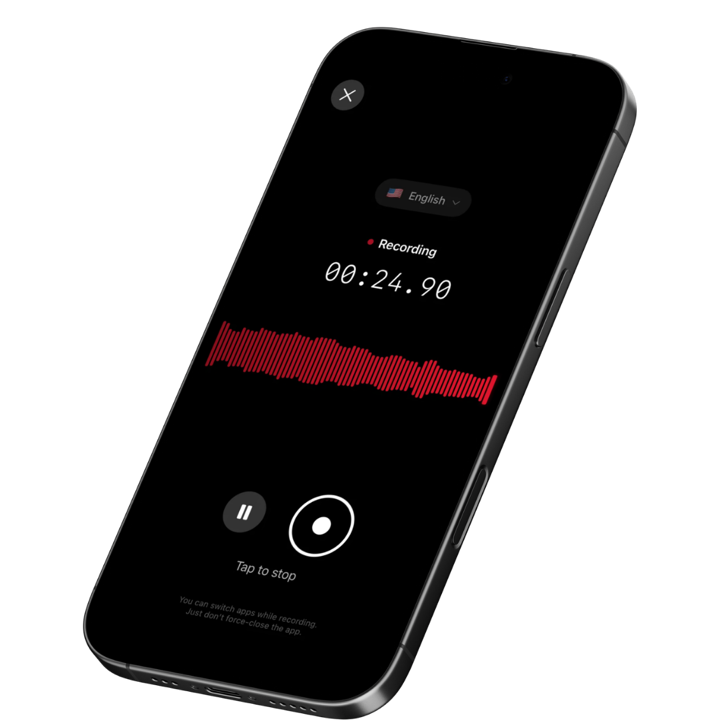
In Atlassian's 2024 survey, 77% of workers said they are often in meetings that end with plans for another meeting. A written record can help, and Speakwise gives you one on your iPhone. Tap once to record an in-person meeting, or the room side of a hybrid meeting. There is no meeting bot to invite. Afterward you get a transcript, an AI summary and action items, so the decisions are written down.
Speakwise users report saving about 73% of their post-meeting follow-up time (Speakwise user surveys). Recording works with the screen off, up to 5 hours per recording, and it records offline and transcribes when you are back online. Transcripts cover 100+ languages with automatic language detection. Start with the iPhone Action Button, Control Center or the Apple Watch app. Accuracy is 95%+ in optimal audio and 92%+ in noisy rooms with several speakers.
The transcript shows who said what through speaker identification. Speaker identification is not included in every plan. When you start your free trial, pick the plan that includes it.
Try Speakwise free for 7 days ($0.00). After that, it starts at $69.99 per year, which is about $5.83 a month, billed yearly. Prices shown are for the US and can differ by country.Download Speakwise from the App Store and end every meeting with a transcript, a summary and action items.
Try Speakwise free for 7 days
Available on the App Store | iOS Optimized

🎯 4.9★ App Store Rating | 📱 Built for iOS
